2026 Puppy Agility Foundation Guide: Safe Flatwork & Body Awareness
Discover the 2026 guide to puppy agility foundation training. Learn safe flatwork, proprioception exercises, and joint protection for future sports dogs.
The Exciting World of Canine Sports: Starting on the Right Paw
As we navigate the 2026 competitive season, dog sports like agility, obedience, and rally continue to surge in popularity. For new puppy owners with dreams of podium finishes, the temptation to rush to the big equipment is immense. However, veterinary sports medicine and top-tier handlers agree: a successful agility dog is built on the flat. Puppy agility foundation training is entirely about body awareness, engagement, and flatwork. In this comprehensive 2026 guide, we will explore how to safely prepare your puppy for a lifetime of canine sports without risking their developing joints, ensuring they grow into confident, driven, and physically sound athletes.
The Science of Canine Growth Plates and Joint Safety
Before introducing any sport-specific movements, it is critical to understand the biological limitations of a growing puppy. Puppies possess open growth plates at the ends of their long bones. These areas of developing cartilage are highly susceptible to injury from repetitive impact, concussive forces, and extreme extension. According to current 2026 veterinary consensus, these growth plates do not fully close and ossify into solid bone until a dog is between 12 and 18 months of age, depending on the breed and size.
Because of this, jumping, weaving through tightly spaced poles, and performing high-impact A-frame or dogwalk contacts are strictly forbidden for puppies. Repetitive stress on open growth plates can lead to microfractures, asymmetric bone growth, and early-onset osteoarthritis. The American Kennel Club (AKC) Agility guidelines and organizations like the United States Dog Agility Association (USDAA) strictly regulate jump heights and competition ages to protect young dogs. Your role during the puppy's first year is to build the 'software' (the brain and the muscles) without damaging the 'hardware' (the skeleton and joints).
What is Flatwork and Why Does it Matter?
Flatwork refers to all the agility training that happens on the ground, without any elevated or complex equipment. In 2026, elite handlers spend up to 80% of their foundational training time on flatwork. It encompasses handling mechanics, directional cues, obstacle focus, and reward delivery. If your puppy does not understand a front cross, a rear cross, or a blind cross on the flat, they will certainly not understand it while moving at 20 miles per hour over a jump. Mastering flatwork ensures that when your puppy is finally physically mature enough to tackle a full course, the communication between you and your dog is already seamless.
Core Foundation Exercises for Puppies (8 Weeks to 6 Months)
Keep all training sessions incredibly short. A puppy's attention span and physical stamina are limited. Aim for three to five minutes of active training, followed by a nap or free play. Here are the essential flatwork exercises to master in 2026:
1. Hand and Bowl Targeting
Teaching your puppy to touch a target with their nose is the foundation of obstacle commitment. Start by presenting your flat palm. The moment the puppy's nose touches your hand, mark the behavior with a clicker or a verbal 'yes' and deliver a high-value treat. Once mastered, transfer this behavior to a plastic lid or a specialized target disc on the ground. This will eventually be used to teach them to hit the bottom contact zone of the A-frame and dogwalk safely.
2. Rear-End Awareness (The Perch Work)
Most puppies are entirely unaware of their back feet. Rear-end awareness is crucial for navigating weave poles and making tight, collected turns on an agility course. Use a low, stable platform (like a thick book or a low wooden block). Lure the puppy to put their front paws on the block. Then, using a food lure, slowly move their head in a circle. Their front paws will stay planted while their back paws step around the block. This 'pivot' exercise builds incredible hindquarter strength and coordination.
3. Recall to Side (Heel Position)
In agility, your dog needs to return to your side smoothly after completing an obstacle. Stand with a treat in your left hand. Lure the puppy around behind your legs or directly to your left side, marking and rewarding when their shoulder is aligned with your leg. This builds the muscle memory for smooth transitions between obstacles on the course.
4. Cavaletti Poles for Stride Regulation
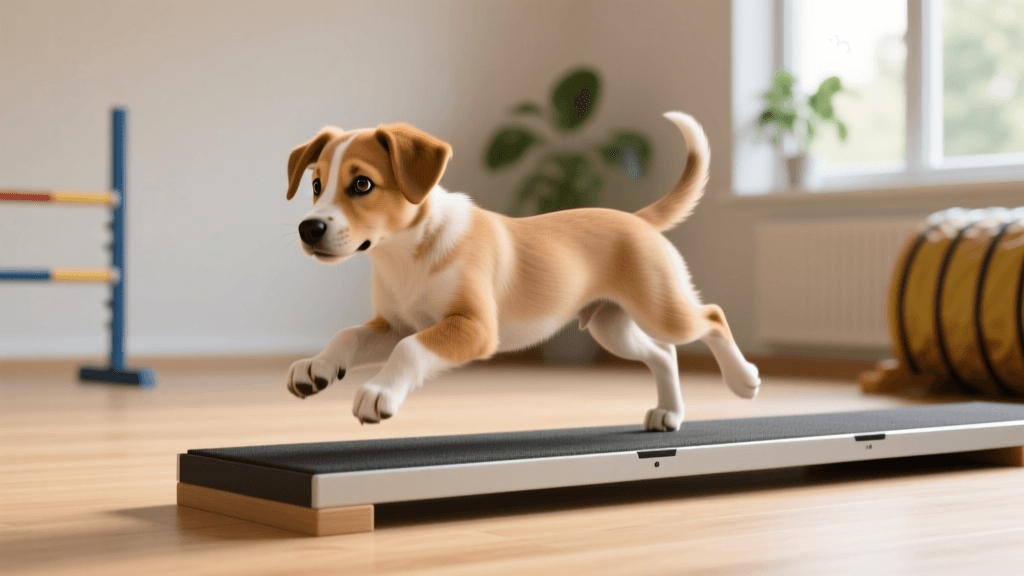
Cavaletti poles are simply wooden or PVC poles laid flat on the ground. Set them slightly apart (based on your puppy's natural walking stride). Walking over these poles forces the puppy to lift their feet, articulate their joints, and think about foot placement. It is an excellent low-impact exercise that builds topline muscle and proprioception without any concussive landing forces.
2026 Proprioception Gear Comparison for Puppies
Proprioception is the body's ability to sense its location, movements, and actions. Utilizing specialized inflatable gear is a staple in modern puppy conditioning. Below is a comparison of the top puppy-safe proprioception tools available in 2026, widely recommended by canine physical therapists and featured in top publications like Clean Run.
| Equipment | Primary Benefit | Approx. 2026 Cost | Safety Note for Puppies |
|---|---|---|---|
| FitPAWS Paw Pods (Set of 4) | Isolates individual limbs; builds core stability and balance. | $45 - $55 | Ensure pods are placed on a non-slip mat to prevent splaying. |
| FitPAWS Donut | Encourages weight shifting; excellent for standing balance. | $35 - $45 | Do not force the puppy onto it; let them explore and step in voluntarily. |
| Balance Disc (Half-Sphere) | General core engagement; introduces unstable surfaces safely. | $25 - $35 | Keep inflation low for beginners to prevent ankle rolls. |
| Adjustable Cavaletti Set | Stride regulation, spinal flexibility, and foot targeting. | $60 - $85 | Always keep poles on the ground for puppies under 12 months. |
Building Drive and Reward Mechanics
An agility dog must possess a high level of drive and enthusiasm for the game. While food is an excellent tool for shaping precise behaviors like targeting and pivoting, toy drive (specifically tug) is what will eventually fuel speed and excitement on the course. In 2026, the most successful handlers utilize 'prey drive' mechanics to build tug skills.
Use a long, fleece tug toy. Drag it along the ground away from the puppy to trigger their chase instinct. When they grab it, engage in a gentle game of tug, allowing the puppy to win frequently. This builds their confidence and creates a powerful reward that can be delivered instantly on the field. Crucially, you must also teach the 'out' or 'drop' command, ensuring the puppy releases the toy cleanly so the training flow is not interrupted.
Structuring the Perfect 5-Minute Puppy Session
Mental fatigue sets in much faster than physical fatigue for a young puppy. A 15-minute training session can leave an 8-week-old puppy overstimulated, frustrated, and shut down. The golden rule of puppy sports training is to leave them wanting more. Structure your sessions as follows:
- Minute 1: Engagement and play. Get the puppy focused on you using a tug toy or high-value treats.
- Minutes 2-4: Active learning. Introduce one new flatwork concept (e.g., rear-end pivots) and practice a known concept (e.g., hand targeting).
- Minute 5: Jackpot reward and cool down. End on a massive success with a flurry of treats or a favorite game, then put the gear away.
When to Introduce Real Equipment
Patience is the ultimate virtue in dog sports. While flatwork and ground-level proprioception can begin as soon as your puppy comes home, actual agility equipment must be introduced on a strict timeline. Low, collapsed tunnels can be introduced around 6 months of age to build confidence in dark, confined spaces. However, jumping and contact equipment should remain completely off-limits until your veterinarian confirms via X-ray that the puppy's growth plates have fully closed, typically between 12 and 15 months for medium breeds, and up to 18 months for giant breeds.
Conclusion: Investing in the Long Game
Raising a puppy for dog sports is a marathon, not a sprint. By dedicating the first year of your puppy's life to safe flatwork, body awareness, and drive building, you are laying an indestructible foundation. The 2026 competitive landscape rewards dogs that are not only fast but also deeply connected to their handlers and physically resilient. Protect those growth plates, master the flatwork, and enjoy the incredible journey of watching your puppy grow into a confident, capable, and joyful canine athlete.
hannah-wickes
All our authors care for dogs every day — read more of their work on the authors page.