Getting a Mobility Service Dog: 2026 Breed & Home Guide
Discover the best mobility assistance dog breeds for 2026 and learn how to prepare your smart home with ADA-compliant gear for your new service dog.
Introduction to Mobility Assistance Dogs in 2026
Bringing a mobility assistance dog into your life is a profound decision that bridges the gap between independence and daily physical challenges. Unlike emotional support animals, mobility service dogs are highly trained working animals designed to perform specific, physically demanding tasks. These tasks range from providing counterbalance and brace work for individuals with vestibular disorders or spinal cord injuries, to pulling manual wheelchairs, retrieving heavy objects, and even operating adaptive smart home switches.
According to the U.S. Department of Justice ADA Guidelines, service animals are strictly defined as dogs that are individually trained to do work or perform tasks for people with disabilities. As we navigate 2026, advancements in veterinary orthopedic screening and smart home technology have revolutionized how we select, train, and integrate these incredible canine partners into our daily lives. This comprehensive guide will walk you through the best breeds for mobility work, the realities of sourcing a dog, and how to optimize your living space for a working dog's physical and mental well-being.
Top Mobility Service Dog Breeds for 2026
When selecting a breed for mobility tasks, size, joint health, stamina, and temperament are paramount. Brace work and wheelchair pulling require dogs that possess significant physical mass—typically a minimum of 55 pounds—and the structural integrity to handle repetitive stress without developing early-onset dysplasia. In 2026, accredited training programs heavily rely on PennHIP and OFA (Orthopedic Foundation for Animals) scoring to ensure breeding lines are free from hereditary joint issues.
| Breed | Ideal Mobility Tasks | Avg. Adult Weight | 2026 Program Waitlist |
|---|---|---|---|
| Labrador Retriever | Brace work, heavy retrieval, wheelchair pulling | 65 - 80 lbs | 18 - 24 months |
| Golden Retriever | Counterbalance, item retrieval, door opening | 60 - 75 lbs | 20 - 26 months |
| Standard Poodle | Light brace work, smart home activation, allergy-friendly tasks | 50 - 70 lbs | 12 - 18 months |
| Bernese Mountain Dog | Heavy wheelchair pulling, deep pressure therapy, bracing | 85 - 115 lbs | 24 - 36 months |
| German Shepherd | Mobility support, balance assistance, medical alert crossover | 65 - 90 lbs | 15 - 20 months |
While Labrador and Golden Retrievers remain the gold standard due to their biddability and structural soundness, Standard Poodles have surged in popularity by 2026 for handlers with severe allergies who still require a dog capable of light-to-moderate brace work and smart-home interaction.
Sourcing Your Dog: ADI-Accredited Programs vs. Owner-Training
Acquiring a fully trained mobility service dog is a significant financial and temporal investment. In 2026, the average cost to purchase a fully trained mobility dog from a reputable nonprofit or private organization ranges from $35,000 to $55,000. However, many handlers pay little to nothing out-of-pocket due to grant funding, community fundraising, and nonprofit sponsorships.
It is critical to work with organizations accredited by Assistance Dogs International (ADI). ADI accreditation ensures that the program adheres to rigorous ethical standards regarding dog welfare, handler training, and public access preparation. Owner-training is another viable route, particularly for those with prior dog-handling experience. However, training a dog for physical mobility tasks like brace work requires the guidance of a certified veterinary behaviorist and a specialized mobility dog trainer to ensure the dog is not physically harmed by improper weight distribution or premature task-loading.
Preparing Your Home: Accessibility & Smart Tech Integration
Preparing your home for a mobility service dog goes far beyond buying a bed and food bowls. You must create an environment that protects the dog's joints while simultaneously allowing the dog to assist you seamlessly. Furthermore, the 2026 landscape of smart home technology offers unprecedented synergy between handler accessibility and canine assistance.
Flooring and Joint Protection
Mobility dogs put immense strain on their joints, particularly their carpal (wrist) and tarsal (ankle) joints, when performing brace work on slippery surfaces. Standard hardwood or polished tile can lead to micro-tears in the ligaments and accelerate osteoarthritis.
- Interlocking Foam Mats: High-density EVA foam mats in the dog's primary resting and working areas provide essential shock absorption.
- Low-Pile Carpeting: Offers excellent traction for wheelchair pulling and brace work without trapping dander or impeding wheelchair wheels.
- Area Rugs with Non-Slip Pads: Place these strategically along hallways and near entryways where the dog will need to halt suddenly while bracing.
Smart Home Synergy and the Matter Protocol
In 2026, the universal Matter protocol has made smart home devices more reliable and locally processed than ever before. This is a game-changer for mobility handlers. While your dog can be trained to pull open doors or press large adaptive buttons, integrating smart tech reduces the physical toll on the dog.
- Voice-Activated Smart Locks: Devices like the Yale Assure Lock 2 allow you to unlock doors via voice command, saving your dog from the repetitive strain of pulling a door handle strap.
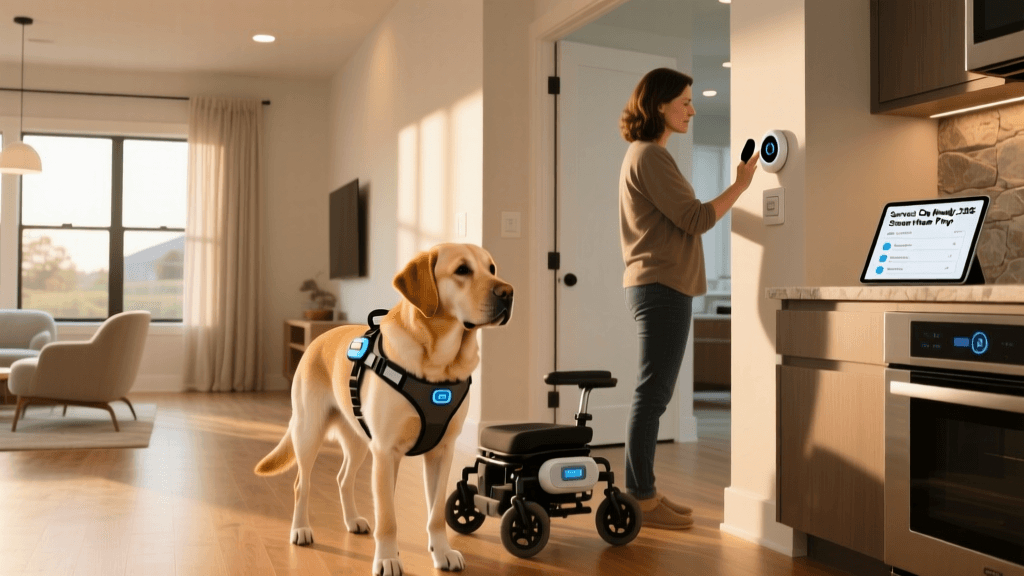
- Adaptive Smart Switches: For moments when your mobility is severely limited, you can train your dog to press a wall-mounted, paw-friendly smart button (like the Flic 2) to trigger lights, call an elevator, or adjust the thermostat.
- Automated Feeding and Hydration: Smart feeders ensure the dog's routine is maintained even if the handler is experiencing a high-symptom flare-up day.
First-Day Essentials and Mobility Gear
When your mobility dog arrives, having the correct ergonomic gear is non-negotiable. Standard pet harnesses are entirely unsuitable for mobility work and can cause severe spinal and tracheal injuries to the dog.
The Mobility Harness
For brace work, you need a custom-fitted mobility harness with a rigid handle that distributes your weight across the dog's chest and ribcage, rather than their spine. Brands like Doggie Design and Custom Canine offer harnesses engineered with aerospace-grade materials that provide lateral support. For wheelchair pulling, a specialized pulling harness with a spreader bar and bungee leash system is required to absorb the shock of sudden stops.
Orthopedic Resting Zones
A working dog's recovery time is just as important as their working hours. Investing in a high-quality orthopedic bed is mandatory. The Big Barker 7-inch Orthopedic Dog Bed remains a top recommendation in 2026 due to its therapeutic foam, which is clinically proven to improve joint function and reduce pain in large working breeds. Place the bed in a quiet, temperature-controlled zone away from high-traffic areas to ensure your dog can decompress after a long day of public access work.
Pro Tip for 2026: Always carry a portable, foldable orthopedic mat when traveling. Public floors in restaurants and airports are unforgiving on a mobility dog's joints, and providing a designated, comfortable resting mat ensures your dog remains physically sound and mentally focused while tucked under your chair or wheelchair.
Veterinary and Orthopedic Screening
Before a dog is cleared for mobility tasks, they must undergo rigorous veterinary screening. In 2026, leading veterinary sports medicine specialists recommend baseline gait analysis and digital X-rays at 12 months, with final clearance for heavy brace work only occurring after the dog's growth plates have fully fused—typically between 18 and 24 months of age. Regular canine massage, chiropractic adjustments, and hydrotherapy are now considered standard maintenance for working mobility dogs, much like physical therapy for human athletes.
Final Thoughts on Your 2026 Journey
Getting a mobility service dog is a life-altering experience that fosters unparalleled independence and companionship. By carefully selecting the right breed, partnering with ADI-accredited programs, and thoughtfully preparing your home with joint-friendly flooring and modern smart technology, you set the foundation for a successful, long-lasting partnership. Remember that your mobility dog is not just a tool, but a dedicated partner who relies on you to protect their physical health and advocate for their well-being in a world that is still learning to accommodate working dogs. With the right preparation, 2026 can be the year you reclaim your mobility and forge an unbreakable bond with your new canine partner.
beth-carrasco
All our authors care for dogs every day — read more of their work on the authors page.