Leash Reactivity vs Aggression: Expert Behavior Guide
Discover the root causes of leash reactivity vs aggression. Expert behavior analysis, actionable training protocols, and gear recommendations for dogs.
The Ethology of the Leash: Why Restraint Alters Behavior
When evaluating canine behavior, one of the most common misconceptions among dog owners is equating leash reactivity with true aggression. As a behaviorist, it is critical to distinguish between these two distinct emotional states, as the underlying neurochemistry and required modification protocols differ vastly. Leash reactivity is primarily an emotional response rooted in fear, anxiety, or barrier frustration. When a dog is tethered, their natural 'flight' option in the fight-or-flight response is artificially removed. Knowing they cannot escape a perceived threat (an approaching dog, a stranger, or a skateboard), the dog defaults to 'fight' behaviors—such as barking, lunging, and snarling—to increase the distance between themselves and the trigger.
Conversely, true aggression is often characterized by an intent to harm, control, or eliminate a threat, and it is not solely dependent on the physical restraint of a leash. According to the ASPCA, true canine aggression involves a complex matrix of genetic predisposition, neurological arousal, and environmental conditioning that persists regardless of whether the dog is tethered. Understanding this distinction is the first step in implementing an effective, science-based behavior modification plan.
Leash Reactivity vs. True Aggression: A Behavioral Breakdown
To accurately assess your dog's behavior, you must analyze their body language, trigger thresholds, and off-leash tendencies. The American Kennel Club (AKC) notes that barrier frustration often manifests as frantic, noisy behavior that completely dissipates once the leash is removed, whereas true aggression remains dangerously consistent. Below is a structured comparison to help you categorize your dog's behavior.
| Behavioral Feature | Leash Reactivity (Fear/Frustration) | True Aggression (Offensive/Defensive) |
|---|---|---|
| Primary Emotion | Anxiety, Fear, or Barrier Frustration | Anger, Predation, or Severe Resource Guarding |
| Off-Leash Behavior | Often friendly, playful, or avoidant | Remains hostile, stiff, or predatory |
| Trigger Distance | Reacts at a distance (e.g., 30-50 feet) | Often waits until closer proximity to strike |
| Body Language | Frantic barking, lunging, high-pitched whining | Stillness, hard stare, low growl, lip curling |
| Recovery Time | Calms down once the trigger is removed | Remains aroused and primed for conflict |
The Expert's Toolkit: Gear, Treats, and Environment
Before beginning any desensitization protocol, you must equip yourself with the proper tools to ensure safety and clear communication. Using the wrong gear can exacerbate fear and cause physical injury to the dog's trachea. Expect a startup cost of approximately $64 to $92 for a professional-grade behavior modification kit.
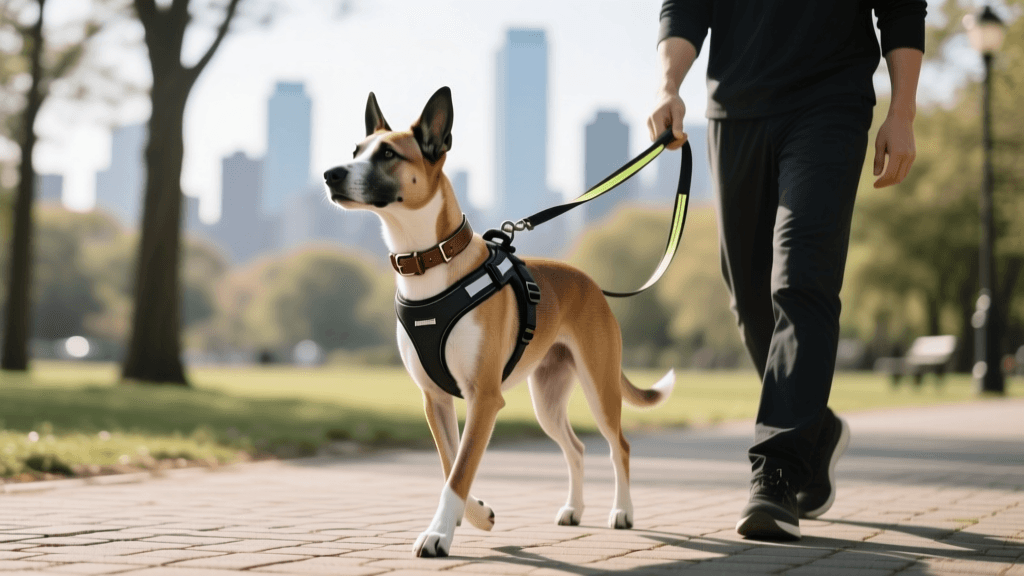
- The Harness: Avoid standard back-clip harnesses, which can encourage pulling and give the dog leverage to lunge. Invest in a front-clip harness like the Freedom No-Pull Harness ($28-$34). The dual-clip system allows you to gently redirect the dog's center of gravity toward you when they lunge, safely neutralizing their forward momentum without causing pain.
- The Leash: Retractables are strictly prohibited in behavior modification. They teach dogs that pulling creates more leash, and the thin cord can cause severe friction burns. Use a 6-foot Mendota Biothane Leash ($25-$40). Biothane is waterproof, easy to sanitize, and provides a secure, non-slip grip even if the dog pulls suddenly.
- High-Value Reinforcers: Dry kibble will not compete with the adrenaline of a trigger. You need 'jackpot' treats to alter the dog's neurochemical response. Use Zuke's Mini Naturals ($8) for rapid-fire rewarding, and Stella & Chewy's Freeze-Dried Beef Liver ($15) for high-intensity triggers. Keep treats in a dedicated treat pouch on your hip for rapid access.
- The Marker: An i-Click Box Clicker ($3) provides a consistent, emotionless acoustic marker that pinpoints the exact millisecond the dog performs the desired behavior, bridging the gap between the action and the food reward.
Step-by-Step Behavior Modification Protocol
The gold standard for treating leash reactivity is Desensitization and Counter-Conditioning (DS/CC). This protocol rewires the dog's amygdala, changing their emotional response to a trigger from 'threat' to 'predictor of good things.' The American Veterinary Society of Animal Behavior (AVSAB) strongly advises against using punishment-based tools (like prong or shock collars) for reactivity, as suppressing the outward symptoms (barking) without addressing the internal fear often leads to a sudden, unprovoked bite later on.
Phase 1: Mapping the Sub-Threshold Distance
Your dog has a 'threshold'—the exact distance at which they notice a trigger but are still capable of processing information and eating treats. For many reactive dogs, this sub-threshold distance is between 40 and 60 feet. If your dog is barking, lunging, or refusing food, you are over threshold. The cognitive brain (cerebral cortex) has shut down, and the emotional brain (amygdala) has taken over. You must start all training at a sub-threshold distance, which may require finding a quiet park, an empty tennis court, or hiring a 'decoy' dog handler to stand at a measured distance.
Phase 2: The Engage-Disengage Game
This game teaches the dog to voluntarily look away from the trigger and check in with you. Keep sessions short—no more than 15 minutes per day to prevent cortisol fatigue.
- Engage: Stand at your sub-threshold distance (e.g., 50 feet) with your dog on their 6-foot leash. Wait for the dog to notice the trigger (e.g., another dog walking by).
- Mark the Look: The exact moment your dog looks at the trigger, but before they bark or stiffen (within 0.5 seconds), click your clicker or use a verbal marker like 'Yes!'.
- Disengage and Reward: Deliver a high-value treat within 2 seconds. The dog will naturally turn away from the trigger to eat the treat. This physical disengagement breaks the visual fixation and lowers arousal.
- Repeat and Shape: As the dog improves, wait a half-second longer before marking. You are shaping the dog to voluntarily look at the trigger, then look back at you without needing the clicker first. This builds a new neural pathway: 'Seeing a dog means I should look at my human for liver.'
Managing Setbacks and Threshold Flooding
Behavior modification is rarely linear. You will inevitably experience 'threshold flooding'—a scenario where a trigger appears too quickly, off-leash dogs approach, or multiple triggers stack together (e.g., a loud truck drives by while a dog barks nearby). When your dog goes over threshold, do not yell, jerk the leash, or punish them. Punishment during an amygdala hijack only confirms to the dog that the environment is indeed dangerous, worsening the reactivity.
Instead, execute an 'Emergency U-Turn.' Cheerfully say 'Let's go!', turn 180 degrees, and jog away from the trigger while tossing high-value treats on the ground for the dog to sniff and eat as they retreat. Sniffing is a naturally soothing behavior that helps lower the dog's heart rate. Remember that a massive cortisol spike takes approximately 72 hours to fully metabolize out of a dog's system. If your dog has a severe reactive episode on a Tuesday, they will likely be more on edge and have a lower threshold for the rest of the week. Plan for quiet, low-stress 'decompression walks' in nature during this recovery window. With consistent, sub-threshold DS/CC work, most dogs show significant neurological rewiring and a drastic reduction in leash reactivity within 8 to 12 weeks.
anouk-beaumont
All our authors care for dogs every day — read more of their work on the authors page.