Stop Leash Pulling: Front-Clip Harness Psychology 2026
Discover the psychology behind leash pulling and how front-clip no-pull harnesses counter the opposition reflex to improve canine behavior in 2026.
As we navigate the evolving landscape of canine behavioral science in 2026, veterinary behaviorists and certified dog trainers are increasingly looking beyond simple obedience commands to understand the root causes of leash reactivity and pulling. For decades, the standard advice for a dog that pulled was to simply stop walking or use corrective collars. However, modern canine psychology reveals that pulling is rarely an act of stubborn defiance. Instead, it is deeply rooted in a biological phenomenon known as the opposition reflex. Understanding this reflex is the key to unlocking the true potential of a no-pull dog harness, transforming it from a mere physical restraint into a powerful behavioral modification tool.
The Biological Root of Pulling: Thigmotaxis and the Opposition Reflex
To understand why a no-pull harness works, we must first understand why dogs pull in the first place. The opposition reflex, scientifically referred to as thigmotaxis, is an instinctual survival mechanism found in many mammals, including canines. When a dog feels physical pressure against a specific part of its body, its automatic neurological response is to push against that pressure. In the wild, this reflex helps animals push through dense brush, escape the grasp of a predator, or lean into a strong wind.
When you attach a leash to a traditional back-clip harness or a flat collar, the pressure is applied to the dog's chest, neck, or dorsal spine. As the dog moves forward and the leash becomes taut, the pressure triggers the opposition reflex. The dog instinctively leans into the harness, engaging its powerful hindquarters and core muscles to push forward. You are not fighting your dog's willpower; you are fighting millions of years of evolutionary biology. According to the American Kennel Club, recognizing this biological trigger is the first step in effectively retraining a dog to walk politely on a leash.
Why Back-Clip Harnesses Fail the Psychological Test
Back-clip harnesses were originally designed for working dogs, specifically sled dogs, to maximize their pulling efficiency. The dorsal attachment point distributes weight evenly across the chest and shoulders, allowing the dog to throw its entire body weight into the harness without choking. While this is excellent for mushing or weight-pulling sports, it is entirely counterproductive for a pet dog learning loose-leash walking in a busy urban environment.
From a psychological standpoint, a back-clip harness actively rewards and reinforces pulling behavior. The dog learns that leaning forward creates tension, and leaning into tension results in forward movement (especially if the owner eventually gives in and follows the dog). This creates a feedback loop where the harness itself becomes an environmental cue for pulling.
The Front-Clip Advantage: Rewiring Canine Momentum
The front-clip no-pull harness revolutionized leash training by fundamentally altering the biomechanics and psychology of the walk. By placing the leash attachment ring on the dog's sternum (the center of the chest), the harness bypasses the opposition reflex entirely.
When a dog wearing a front-clip harness reaches the end of the leash and tension is applied, the physics of the attachment point gently redirects the dog's center of gravity. Instead of allowing the dog to drive forward like a snowplow, the lateral tension turns the dog's shoulders slightly inward, facing them back toward the handler. Psychologically, this breaks the dog's forward fixation. The opposition reflex is not triggered because the pressure is not applied to the dorsal spine or the back of the neck. Instead of leaning in, the dog naturally rebalances, making it physically difficult and psychologically unrewarding to continue pulling.
2026 Biomechanical Standards: The Y-Shaped Chest Plate
As of 2026, the veterinary and canine rehabilitation communities have established strict guidelines regarding the physical design of no-pull harnesses. The outdated 'T-shaped' harnesses, which feature a horizontal strap cutting directly across the dog's biceps brachii and shoulder joints, are now widely condemned for restricting natural gait and causing long-term joint issues.
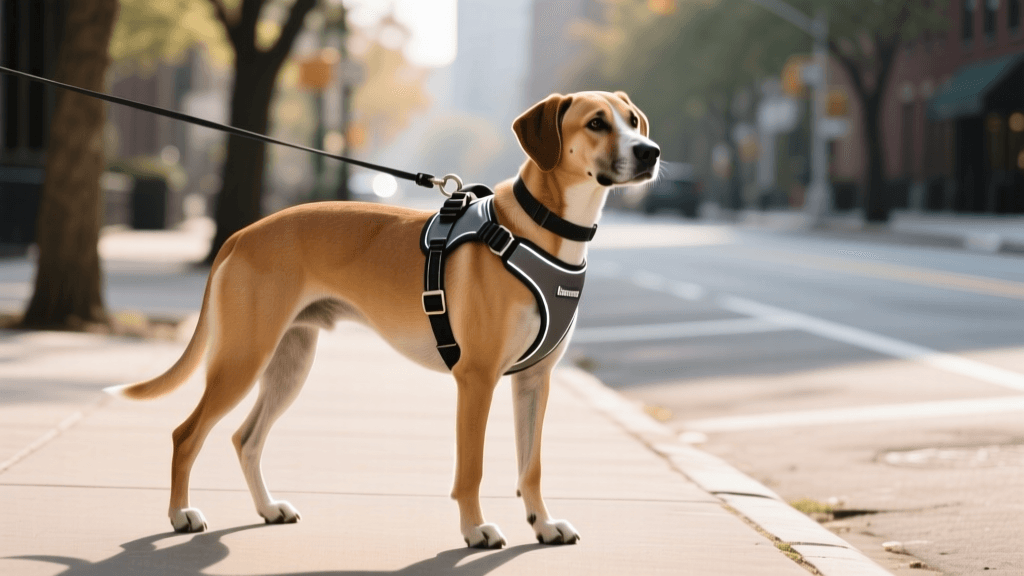
When shopping for a front-clip harness today, you must look for a 'Y-shaped' chest plate. The Y-shape follows the natural anatomical lines of the dog's sternum and ribcage, leaving the shoulder joints completely unrestricted. This allows for full extension of the front legs, which is critical for maintaining proper biomechanics and preventing compensatory injuries. Furthermore, modern canine physical therapists note that restricting the shoulder extension alters the dog's natural four-beat gait, forcing them to shorten their stride and compensate with their lower back and hindquarters. Over months and years, this compensation can lead to premature arthritis and spinal discomfort. Therefore, investing in a properly fitted Y-shaped harness is not just a behavioral choice; it is a critical component of your dog's long-term orthopedic health. High-quality Y-shaped front-clip harnesses in 2026 typically range from $45 to $85, featuring breathable mesh, padded sternum straps, and dual-clip options for advanced training.
Harness Configuration and Behavioral Impact Comparison
| Equipment Type | Attachment Point | Opposition Reflex Triggered? | Psychological Impact on Pulling | 2026 Veterinary Recommendation |
|---|---|---|---|---|
| Standard Flat Collar | Top of Neck | Yes (High) | Encourages choking and forward leaning; high trachea risk. | Not recommended for pullers. |
| Back-Clip Harness | Dorsal Spine | Yes (Maximum) | Reinforces sled-dog pulling mechanics; rewards tension. | Only for car travel or non-pullers. |
| Front-Clip Y-Harness | Sternum (Chest) | No | Redirects momentum; breaks forward fixation without pain. | Highly recommended for training. |
| Head Halter | Muzzle/Snout | No | Provides steering control but requires extensive desensitization to prevent pawing and anxiety. | Recommended for severe reactivity with professional guidance. |
A 14-Day Front-Clip Harness Desensitization Protocol
Simply strapping a new piece of equipment onto a dog will not instantly cure leash reactivity. Many dogs exhibit 'harness freeze' or attempt to chew through the chest strap because the sensation of the Y-plate resting against their sternum feels novel and restrictive. To leverage the psychological benefits of the harness, you must condition your dog to view it as a predictor of positive outcomes.
Days 1-3: The Scent and Sight Association
Place the harness on the floor near your dog's food bowl or favorite resting spot. Do not attempt to put it on. Every time your dog investigates the harness, mark the behavior with a verbal 'yes' or a clicker, and deliver a high-value treat (like freeze-dried liver or boiled chicken) within 300 milliseconds. This builds a positive classical conditioning loop.
Days 4-7: The Head-Loop Targeting
Hold the neck loop open in a circle. Use a treat to lure your dog's nose through the loop. The moment their head passes through, reward heavily. Repeat this 10 to 15 times per session, twice a day. Never force the loop over the dog's ears or eyes, as this triggers a claustrophobic panic response.
Days 8-10: Girth Strap Fastening
Once the dog willingly puts its head through the loop, gently reach behind the front legs to clip the girth straps. Start by clipping it for just one second, treating continuously, and then unclipping it. Gradually increase the duration the harness remains fastened while engaging your dog in a favorite indoor game, like tug or fetch, to distract them from the physical sensation.
Days 11-14: The Front-Clip Leash Introduction
Attach a lightweight, 4-foot biothane or leather leash to the front sternum ring indoors. Let the leash drag (under strict supervision to prevent tangling) while your dog moves around the house. This acclimates them to the subtle weight and drag of the leash on the front clip before introducing the chaotic variables of the outdoor environment.
Merging Equipment with Cognitive Training
It is vital to remember that a no-pull harness is a management tool, not a standalone training solution. The front-clip provides you with the mechanical advantage needed to keep your dog safe and prevent them from practicing the habit of pulling, but it does not teach them exactly where to walk. The ASPCA emphasizes that consistent positive reinforcement is required to teach a dog the desired position beside your leg.
If your dog hits the end of the leash and the front clip engages, use that moment of redirection as a cue. When the dog turns back toward you, immediately mark the eye contact with a cheerful 'yes!' and deliver a treat at your hip. This teaches the dog that the gentle pressure of the front clip is not a physical barrier, but rather a tactile cue to check in with the handler. This concept, known as leash pressure conditioning, transforms the harness from a restraining device into a sophisticated communication channel between you and your dog.
Use the front-clip harness to manage the dog's momentum, and pair it with a 'magnet hand' technique. Keep a handful of treats in the hand closest to the dog, holding it right at the seam of your pant leg where you want the dog's shoulder to align. Reward the dog every 3 to 5 steps for maintaining slack in the leash. Over time, fade the treats to a variable ratio schedule, rewarding only the most focused and relaxed walking. By combining the biomechanical redirection of a 2026 Y-shaped front-clip harness with modern, force-free cognitive training, you address both the physical and psychological roots of pulling, resulting in a happier, healthier, and more connected walking partner.
hannah-wickes
All our authors care for dogs every day — read more of their work on the authors page.