Force-Free Puppy Training: Best Enrichment Gear 2026
Discover the best force-free enrichment gear and positive reinforcement setup tips for bringing a new puppy home in 2026. Build trust without aversives.
Setting the Stage for a Force-Free Life in 2026
Bringing a new dog or puppy into your home is one of life’s most rewarding milestones. However, the transition from a shelter, breeder, or foster home to your living room can be incredibly overwhelming for a canine. As of 2026, the veterinary and behavioral science communities have reached a definitive consensus: force-free, positive reinforcement (R+) methods are not just kinder—they are scientifically proven to be more effective and safer than dominance-based or aversive training. Preparing your home with the right enrichment gear and positive reinforcement tools before your dog’s paws ever touch your floor is the ultimate key to a seamless transition.
Setting up a force-free environment means proactively managing your space to prevent unwanted behaviors while providing abundant, appropriate outlets for your dog’s natural instincts. This guide will walk you through the essential force-free gear, enrichment setups, and first-week milestones you need to welcome your new companion with confidence and compassion.
Why Force-Free Preparation Matters for New Dogs
When a dog enters a new environment, their cortisol (stress hormone) levels naturally spike. Traditional, outdated methods often relied on correcting stress-induced behaviors with aversive tools like choke chains, prong collars, or electronic shock collars. Today, we know that suppressing behavior through fear or pain does not teach the dog what to do; it merely masks the symptom while damaging the human-animal bond and risking severe behavioral fallout, such as redirected aggression or learned helplessness.
According to the American Veterinary Society of Animal Behavior (AVSAB), humane, reward-based training should be the standard of care for all dogs. By utilizing positive reinforcement, you are actively building neural pathways associated with safety, trust, and joy. Furthermore, the Fear Free Pets initiative emphasizes that reducing fear, anxiety, and stress (FAS) in the home environment is critical for a dog's overall physical and emotional well-being. Equipping your home with force-free gear ensures that your dog learns through engagement and choice, rather than coercion.
Essential Force-Free Gear for Your 2026 Setup
To build a successful positive reinforcement ecosystem, you need the right tools. Here are the top force-free essentials for your new dog’s first month.
1. Front-Clip No-Pull Harnesses
Ditch the traditional flat collar for walks, which can put dangerous pressure on a dog’s fragile trachea and thyroid gland. A high-quality front-clip harness, such as the Blue-9 Balance Harness or the Perfect Fit Harness, is a force-free staple. These harnesses feature a leash attachment point on the chest. When the dog pulls, the biomechanics gently redirect their momentum back toward you, naturally discouraging pulling without inflicting pain or restricting shoulder movement. In 2026, expect to invest between $45 and $65 for a properly fitted, multi-point adjustable harness.
2. Interactive Enrichment Feeders
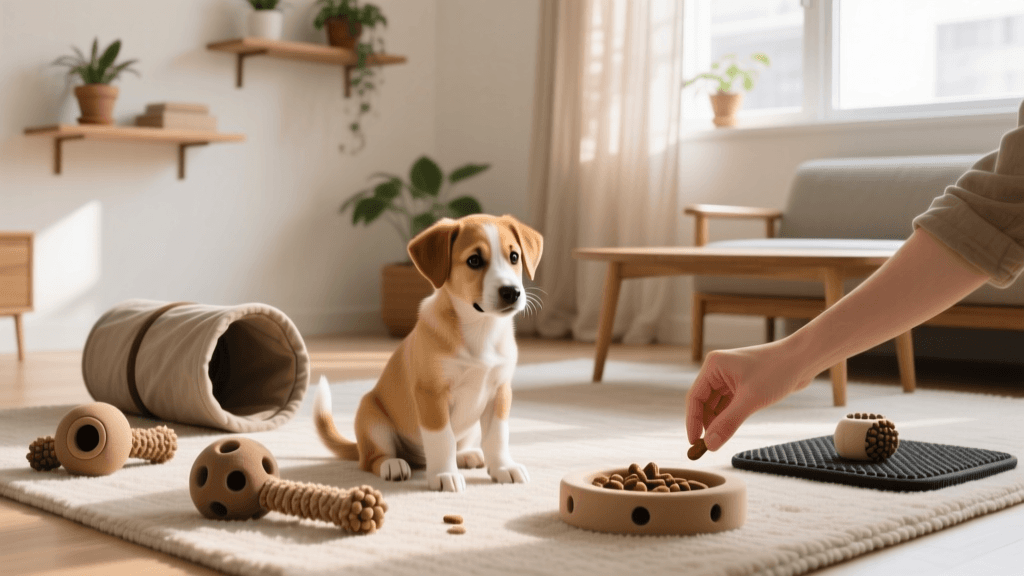
Dogs are natural foragers. Feeding them exclusively from a stainless-steel bowl is a missed opportunity for mental stimulation. Interactive feeders like the West Paw Toppl or high-quality wool Snuffle Mats tap into a dog’s olfactory senses. Sniffing has been shown to lower a dog's heart rate and promote a state of calm. Stuff a Toppl with a mixture of soaked kibble, plain pumpkin puree, and low-sodium bone broth, then freeze it. This provides a long-lasting, soothing activity that is perfect for crate training or keeping your puppy occupied while you work from home.
3. Biothane Long Lines (15 to 30 Feet)
Decompression walks—often called 'sniffaris'—are vital for a new dog's mental health. A standard 4-foot leash does not allow enough freedom for a dog to fully explore and process their new neighborhood. A 15-foot or 30-foot long line made from Biothane is the 2026 gold standard. Biothane is waterproof, mud-proof, and doesn't absorb odors or tangle easily like cotton or nylon. It allows you to give your dog the freedom to sniff and decompress while maintaining safety near roads, completely eliminating the need for harsh 'leash pops' or corrections.
4. Magnetic-Closure Treat Pouches
In positive reinforcement training, timing is everything. You have roughly 1.5 seconds to mark and reward a desired behavior before the dog loses the association. Fumbling with zippers or drawstrings ruins your timing. A premium treat pouch with a silent, magnetic closure (like the Dogline Treat Pouch or similar modern equivalents) allows for instant access to high-value rewards like boiled chicken, freeze-dried liver, or cheese. Wear it on your hip or cross-body during the first few weeks to constantly reward voluntary check-ins and calm behavior.
Tool Comparison: Aversive vs. Force-Free Methods
Understanding the difference between outdated aversive tools and modern force-free alternatives is crucial for any new dog owner. The table below highlights the 2026 veterinary and behavioral consensus on common walking and training equipment.
| Tool Category | Specific Example | Mechanism of Action | Behavioral Impact & 2026 Consensus |
|---|---|---|---|
| Aversive (Avoid) | Prong / Pinch Collar | Inflicts localized pain/discomfort on the neck | Increases fear, risks tracheal damage, and can cause redirected aggression. |
| Force-Free (Use) | Front-Clip Harness | Biomechanical redirection of the chest | Teaches loose-leash walking safely; preserves the human-dog bond. |
| Aversive (Avoid) | Electronic Shock Collar | Delivers electric shock or vibration | Suppresses behavior temporarily; high risk of severe anxiety and fallout. |
| Force-Free (Use) | Long Line + High-Value Treats | Positive reinforcement and environmental management | Builds a reliable, joyful recall and allows safe decompression. |
Setting Up 'Decompression Zones' in Your Home
A new dog needs a sanctuary—a place where they can retreat when the sensory input of a new home becomes too much. This is often a crate or an exercise pen, but it must be introduced using positive association. Never use the crate as a place for punishment or 'time-outs.' Instead, make it a decompression zone.
Line the space with a washable, chew-resistant bed. Introduce lick mats (such as the Hyper Pet IQ Treat Mat) smeared with xylitol-free peanut butter or plain goat milk. The repetitive action of licking releases endorphins in a dog's brain, acting as a natural self-soothing mechanism. When your dog voluntarily enters this zone, quietly drop a high-value treat inside without making a big fuss. This teaches them that their safe space is a generator of good things, aligning perfectly with the American Kennel Club's (AKC) guidelines on reward-based crate training.
First-Week Force-Free Training Milestones
Your first week is not about teaching complex tricks; it is about establishing trust, communication, and household routines. Focus on these three force-free milestones:
- The Name Game: Say your dog's name in a cheerful tone. The exact second they look at you, use a marker word like 'Yes!' or a clicker, and immediately deliver a treat. Repeat this in various low-distraction rooms to build a strong, positive orienting response.
- Management-Based Potty Training: Accidents happen. Never rub a dog's nose in it or yell, as this only teaches them to hide from you when they need to eliminate. Instead, manage the environment. Take them out on a leash every 1-2 hours, after meals, and after naps. Throw a 'potty party' with high-value treats and praise the moment they eliminate outside.
- Voluntary Check-Ins: When walking on your long line, every time your dog voluntarily turns their head to look at you, mark and reward. This builds the foundation for a reliable recall and loose-leash walking without the need for corrective jerks.
Conclusion: Patience and Positivity
Getting a new dog in 2026 means embracing the wealth of knowledge we now have regarding canine cognition and emotional health. By investing in force-free enrichment gear, managing your home environment, and committing to positive reinforcement, you are setting the stage for a lifetime of mutual trust. Ditch the outdated myths of dominance and alpha rolls, and instead, become your dog's advocate, guide, and greatest source of joy.
jonas-cole
All our authors care for dogs every day — read more of their work on the authors page.