2026 Dog Sound Button Training: FluentPet vs Hunger For Words
Discover how to teach your dog to use sound buttons in 2026. We compare FluentPet and Hunger for Words kits and share expert AAC training tips.
The Evolution of Canine Communication in 2026
For decades, dog owners have relied on interpreting tail wags, ear positions, and vocalizations to understand their canine companions. However, as we navigate 2026, the landscape of canine communication has been revolutionized by Augmentative and Alternative Communication (AAC) devices designed specifically for dogs. Sound buttons—recordable pads that allow dogs to "speak" by pressing them with their paws or noses—have moved from viral internet novelties to scientifically backed tools for cognitive enrichment and behavioral management.
Whether you are trying to reduce your dog's separation anxiety, give them a voice in a multi-pet household, or simply deepen your daily bond, teaching your dog to use sound buttons is one of the most rewarding activities you can undertake. In this comprehensive guide, we will explore the science behind canine AAC, compare the two leading hardware ecosystems available this year—FluentPet and Hunger for Words—and provide a step-by-step roadmap to building your dog's vocabulary.
The Science Behind Canine AAC
Before investing in a button kit, it is crucial to understand how dogs process this type of communication. Dogs do not understand English grammar or syntax in the way humans do. Instead, they are masters of associative learning and pattern recognition. When a dog presses a button that says "Outside" and the door immediately opens, they are not necessarily formulating a complex sentence about their desire to explore the yard. Initially, they are simply learning a mechanical sequence: press plastic circle = door opens.
However, cognitive researchers have found that with consistent modeling, dogs begin to associate the specific auditory feedback of the button with the functional outcome, and eventually, the abstract concept. According to ongoing research published by They Can Talk, a cognitive science initiative studying animal language acquisition, animals like dogs and cats can learn to combine buttons to express novel thoughts, report pain, and even comment on their environment. This shifts the dynamic from simple trick training to genuine two-way communication.
2026 Hardware Comparison: FluentPet vs. Hunger for Words
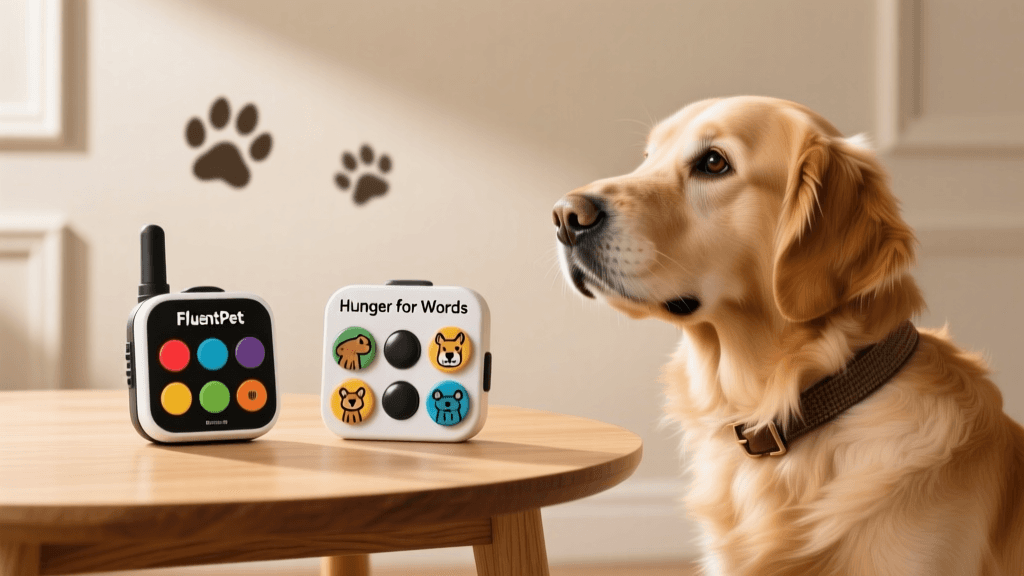
Choosing the right hardware is the first critical decision. In 2026, the market is dominated by two primary systems, each with a distinct philosophy on design and learning. Below is a detailed comparison to help you choose the best fit for your home.
| Feature | FluentPet 2026 Hex-Mat System | Hunger for Words Starter Kit |
|---|---|---|
| Mat Design | Interlocking hexagonal tiles (prevents slipping, allows custom shapes) | Standard rectangular foam mats (grid-based) |
| Button Mechanism | Low-force capacitive touch & mechanical options (ideal for small/senior dogs) | Standard mechanical switch (requires firm paw press) |
| Recording Quality | High-fidelity digital playback, volume control on base | Standard analog recording, fixed volume |
| Scalability | Highly scalable; hex mats snap together seamlessly for 100+ buttons | Moderate; rectangular mats can feel disjointed when expanded |
| Estimated 2026 Price | $150 - $180 (Starter Kit) | $120 - $140 (Starter Kit) |
Our Verdict: If you have a small breed, a senior dog with arthritis, or plan to build a massive vocabulary board, the FluentPet system's low-force buttons and interlocking hex-mats make it the superior choice for 2026. If you are on a strict budget and just want to test the waters with basic words like "Outside" and "Play," Hunger for Words offers a reliable, no-frills entry point.
Getting Started: Location, Setup, and the First Words
Success in button training relies heavily on environmental design. Do not hide the mat in a corner of the laundry room. Place the buttons in a high-traffic area where your family naturally gathers, such as the living room or kitchen. This ensures you are always present to "model" the behavior.
Choosing Your First Three Buttons
Novice trainers often make the mistake of starting with abstract concepts like "Love" or "Mad." Instead, start with high-value, highly motivating functional words. We recommend the following starter trio:
- Outside: The ultimate motivator for most dogs. Use this before every single potty break or walk.
- Play: Use this when initiating a game of tug, fetch, or wrestling.
- All Done: Crucial for setting boundaries. Use this when a play session ends, when the treat puzzle is empty, or when grooming is finished.
The Art of Modeling
Modeling is the process of demonstrating the button's use without forcing your dog's paw onto the device. Forcing the paw creates physical resistance and fear. Instead, follow this sequence:
- Say the word out loud clearly (e.g., "Let's go Outside!").
- Immediately press the "Outside" button yourself.
- Open the door and enthusiastically invite the dog out.
- Repeat this exact sequence every single time for at least two to three weeks before expecting the dog to press it independently.
Integrating Button Training with Canine Body Language
While sound buttons are incredible tools, they do not replace the need to understand your dog's natural physical cues. A dog might press the "Play" button because they have learned it gets your attention, but if their ears are pinned back, their tail is tucked, and they are exhibiting whale eye, they might actually be feeling anxious rather than playful. The American Kennel Club emphasizes that true communication requires reading the whole dog. Use the buttons to give your dog a voice, but always cross-reference their requests with their physical posture to ensure you are meeting their actual emotional and physical needs.
Advanced Modeling: Building a 2026 Vocabulary
Once your dog is reliably pressing their first three buttons, you can begin expanding their board. A great strategy is to categorize buttons by function: Activities (Walk, Car, Couch), Social (Mom, Dad, Dog), Needs (Water, Potty, Hungry), and Descriptors (Big, Small, Fast).
When introducing a new button, pair it with an existing one. For example, if your dog knows "Outside," introduce "Car." Say, "We are getting in the Car to go Outside!" Press Car, then press Outside. This spatial and sequential mapping helps dogs understand that words can be combined to provide more specific context, a major milestone in cognitive development.
Troubleshooting Common Button-Pressing Issues
Even the most dedicated pet parents will encounter roadblocks. Here is how to handle the most frequent challenges documented by canine behaviorists and the Humane Society:
1. The "Button Spam" Phase
The Problem: Your dog discovers that pressing the "Play" button gets you to look at them, so they press it 50 times in a row at 2:00 AM.
The Solution: Do not scold the dog, as this can create a negative association with the board. Instead, implement an "extinction burst" protocol. If the request is unreasonable (e.g., playing fetch at 2 AM), acknowledge the button press with a calm "All Done" or simply ignore the spamming. Only reward the button press when it aligns with your schedule. Consistency is vital; if you give in to spamming even once, you reinforce the behavior.
2. Ignoring the Mat Completely
The Problem: You have modeled for weeks, but your dog shows zero interest in the buttons.
The Solution: Evaluate the placement and the reward value. Is the mat in a scary location near a loud appliance? Move it. Is the reward for pressing "Outside" just going into a boring, fenced yard? Try pairing the button with a high-value activity like a sniffari walk or a trip to the park. Additionally, ensure you are not accidentally blocking the mat with furniture or your own feet.
3. Confusing Similar Sounding Words
The Problem: Your dog presses "Water" when they want to go "Outside" to pee.
The Solution: Dogs process phonetics differently than humans. If two words sound similar or share the same vowel sounds, your dog might struggle to differentiate the auditory feedback. Try re-recording the buttons using distinct, contrasting tones, or change the word entirely (e.g., use "Potty" instead of "Water" for bathroom breaks).
Final Thoughts on Life with a Talking Dog
Teaching your dog to use sound buttons in 2026 is a journey of patience, observation, and profound mutual respect. It requires shifting your perspective from viewing your dog as a pet that simply follows commands to viewing them as an autonomous individual with preferences, desires, and opinions. By investing in a quality system like FluentPet or Hunger for Words, committing to daily modeling, and respecting their natural body language, you will unlock a level of companionship that transcends the traditional human-animal bond. Start small, stay consistent, and prepare to be amazed by what your dog has to say.
jonas-cole
All our authors care for dogs every day — read more of their work on the authors page.