FluentPet Sound Button Training for Dogs: 2026 Guide
Learn how to teach your dog to communicate using FluentPet sound buttons in 2026. Step-by-step HexTile training, vocabulary building, and troubleshooting.
The Rise of Canine AAC in 2026
Augmentative and Alternative Communication (AAC) has fundamentally transformed how we understand and interact with our canine companions. As of 2026, teaching dogs to use sound buttons is no longer a viral internet novelty; it is a scientifically backed training methodology embraced by certified animal behaviorists worldwide. By leveraging a dog's natural ability to associate specific actions with outcomes, AAC sound boards allow dogs to express their needs, desires, and even abstract concepts without relying solely on barking or whining.
According to the ongoing research at the TheyCanTalk project at UC San Diego, dogs possess the cognitive capacity to learn hundreds of words and can even combine them to form rudimentary syntactic structures. This guide will walk you through the exact steps to train your dog using the industry-leading FluentPet HexTile system, ensuring you are utilizing the most up-to-date, positive reinforcement techniques available in 2026.
Why the FluentPet HexTile System Leads the Market
When selecting an AAC system for your dog, the physical design of the board is just as critical as the training methodology. In 2026, the FluentPet HexTile system remains the gold standard for several key reasons:
- Gestalt Perception: Dogs do not read text; they recognize spatial patterns. The hexagonal tiles allow for tight, honeycomb-like clustering, making it easier for dogs to memorize the location of words based on their neighbors.
- Categorization: HexTiles allow you to group words by grammatical category (e.g., nouns on one tile, verbs on another, adjectives on a third). This spatial arrangement accelerates a dog's ability to combine words logically.
- Durability and Tactile Feedback: The 2026 FluentPet buttons feature an improved, low-profile mechanical switch that requires less activation force, accommodating both large breeds and small dogs with delicate paws or noses.
2026 FluentPet Kit Comparison Chart
Choosing the right starter kit depends on your dog's current training level and your long-term communication goals. Below is a comparison of the current 2026 FluentPet offerings:
| Kit Type | Estimated 2026 Price | Included Components | Best For |
|---|---|---|---|
| FluentPet Starter Kit | $29.95 | 1 HexTile, 6 Buttons, Recordable | Beginners testing the waters |
| FluentPet Core Vocabulary | $59.95 | 3 HexTiles, 18 Buttons, Carry Bag | Intermediate learners building sentences |
| FluentPet Pro System | $119.95 | 6 HexTiles, 40+ Buttons, Wall Mounts | Advanced talkers and multi-pet homes |
Note: Prices reflect the standard 2026 retail pricing on the official FluentPet website and may vary slightly during seasonal promotions.
Phase 1: Target Training and Button Mapping
Before introducing the sound buttons, your dog must understand the concept of 'targeting.' Targeting is a foundational behavior where the dog learns to touch a specific object with their nose or paw on cue. The ASPCA's dog training guidelines heavily emphasize positive reinforcement and shaping when introducing novel concepts to dogs.
Step 1: Shaping the Touch
Place a single, unrecorded button (or a small plastic lid) on the floor. The moment your dog sniffs or looks at it, mark the behavior with a clicker or a verbal 'Yes!' and offer a high-value treat. Repeat this until the dog intentionally nudges the object to get the reward.
Step 2: Adding the Auditory Cue
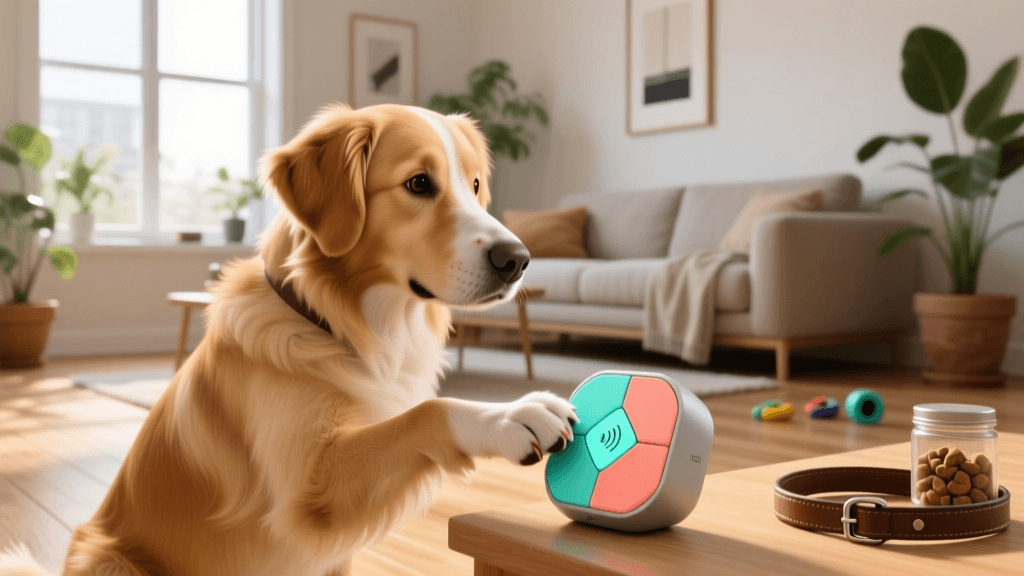
Once the dog is reliably nudging the object, record a highly motivating word onto the button. 'Outside' or 'Play' are the best starting words because they represent activities the dog already loves. Place the button on a single HexTile. When the dog nudges it and the button speaks, immediately fulfill the request. If they press 'Outside,' leash them up and go outside. This builds the crucial associative link: Pressing this specific sound causes this specific outcome.
Phase 2: Building a Functional Core Vocabulary
A common mistake新手 (beginners) make is introducing too many words too quickly. In 2026, behaviorists recommend a 'slow and steady' vocabulary expansion. Introduce only one new button every 5 to 7 days, and only after the dog is reliably using the previous buttons with intention.
Recommended First 10 Words
- Outside (Action/Location)
- Play (Action)
- Water (Resource)
- Hungry (State of being)
- Walk (Action)
- Love / Pet (Affection/Social)
- All Done (Boundary/Cessation)
- Ouch (Pain/Discomfort)
- Help (Assistance)
- Bed (Location)
Always model the word before expecting the dog to use it. If you are taking them outside, say 'Outside' while pressing the button yourself, then open the door. Modeling is the cornerstone of AAC acquisition.
Phase 3: Spatial Arrangement and Syntax
As your dog's vocabulary grows beyond 10 words, spatial arrangement becomes critical. Do not scatter buttons randomly. Use the HexTiles to create a 'keyboard' layout based on parts of speech.
- Verbs (Actions): Group on the left tile (e.g., Play, Walk, Go).
- Nouns (Objects/Locations): Group on the right tile (e.g., Outside, Park, Toy).
- Adjectives/Modifiers: Group on a bottom tile (e.g., Fast, Slow, Big).
This structured layout allows dogs to develop 'motor memory' for grammar. Researchers have observed dogs stringing words together, such as 'Play Outside' or 'Walk Fast.' By keeping categories spatially distinct, you reduce cognitive load and frustration for the learner.
Troubleshooting: Button Mashing and Extinction Bursts
Training is rarely a linear process. You will encounter behavioral hurdles, but understanding the psychology behind them will help you navigate them successfully.
The 'Button Mashing' Phase
Many dogs go through a phase where they press every button on the board in rapid succession. This is often an 'extinction burst' or an expression of excitement. They have realized the buttons yield results, but they haven't refined the specificity. Do not punish the mashing. Instead, wait for a moment of calm, or isolate a single button on a bare floor until the intentionality returns. If they mash 'Outside' and 'Water' and 'Play,' fulfill the most pressing biological need (e.g., go outside), but do not reward the chaotic behavior with excessive play.
Fear of the Sound
Some sensitive breeds may be startled by the mechanical click and digital playback of the button. If your dog retreats after pressing a button, lower the volume (if your 2026 model supports Bluetooth volume control via the app) or record the word in a soft, soothing whisper. Pair the sound with a 'jackpot' reward (a handful of boiled chicken or freeze-dried liver) to counter-condition the fear response.
Ignoring the Board
If your dog stops using the board, evaluate your consistency. Are you modeling the words during daily routines? Are you honoring their requests? If a dog presses 'Play' and you are too busy to engage, they will quickly learn that the board is ineffective. You must honor the communication, even if it means offering a quick 30-second game of tug to validate their request.
Conclusion: Patience and Partnership
Teaching your dog to communicate via AAC sound buttons is a profound journey that deepens the human-animal bond. By utilizing the FluentPet HexTile system, adhering to positive reinforcement principles, and respecting your dog's cognitive processing speed, you will unlock a new dimension of mutual understanding. Remember that every dog learns at their own pace. Celebrate the small victories, maintain a consistent modeling routine, and enjoy the incredible experience of hearing your dog 'speak' in 2026 and beyond.
marcus-aldridge
All our authors care for dogs every day — read more of their work on the authors page.