Best Dog Communication Buttons 2026: FluentPet Review
Discover how AAC sound buttons like FluentPet transform canine communication in 2026. Compare top kits, learn training steps, and decode your dog's signals.
The Rise of Canine AAC: Beyond Basic Commands
For decades, dog owners relied almost exclusively on interpreting tail wags, ear positions, and whines to understand their pets. While reading dog body language remains a foundational skill for any pet parent, the landscape of canine communication has undergone a massive, scientifically validated shift. In 2026, Augmentative and Alternative Communication (AAC) sound buttons have evolved from viral internet novelties into sophisticated, data-driven tools for daily life with your dog.
AAC systems, originally designed for non-verbal humans, allow dogs to express complex desires, physical states, and even abstract concepts by pressing pre-recorded or digitally synthesized sound buttons. Today, we are moving past the simple 'treat' or 'outside' buttons and exploring how dogs combine words to form rudimentary sentences. This comprehensive guide explores the leading 2026 sound button systems, the cognitive science backing them, and a step-by-step protocol to integrate AAC into your multi-pet household.
FluentPet vs. Hunger for Words: 2026 Comparison Chart
When outfitting your home for canine communication, the physical interface matters just as much as the training methodology. Dogs interact with their environment through tactile feedback and spatial memory. Below is a detailed comparison of the two leading AAC systems available in 2026.
| Feature | FluentPet 2026 Smart HexTile Kit | Hunger for Words Traditional Mat |
|---|---|---|
| Base Design | Interlocking hexagonal tiles with tactile grips | Foldable foam mat with Velcro button pockets |
| Button Mechanism | Wireless Bluetooth / RFID smart buttons | Traditional mechanical record/play switches |
| App Integration | Full usage analytics, remote recording, smart home triggers | None (manual recording only) |
| Spatial Mapping | Hexagonal grid mimics natural canine spatial clustering | Linear grid requires linear memorization |
| Price (2026 MSRP) | $149.99 (Starter 6-Button Smart Kit) | $39.99 (Starter 4-Button Mat) |
While the Hunger for Words mat remains an excellent, budget-friendly entry point for beginners, the FluentPet 2026 Smart Kit represents the current gold standard for serious canine AAC. The interlocking hexagonal tiles allow you to group related concepts (like 'Play', 'Park', and 'Ball') in clusters, which aligns with how canine brains categorize associative memories. Furthermore, the Bluetooth integration allows the FluentPet app to log exactly when and how often your dog presses specific buttons, providing invaluable data for identifying behavioral patterns or underlying anxiety.
The Cognitive Science: What Are Dogs Actually Saying?
Skeptics often argue that dogs pressing buttons are merely performing a trained trick to receive a reward, rather than engaging in true communication. However, ongoing research from the TheyCanTalk research initiative at UC San Diego suggests otherwise. By analyzing thousands of hours of button-press data from households worldwide, researchers have documented dogs combining words in novel ways that they were never explicitly trained to use together.
For example, dogs have been recorded pressing 'Stranger' and 'Come' when a delivery driver approaches, or combining 'Ouch' and 'Paw' to indicate a localized injury that the owner had not yet noticed. This demonstrates a level of categorical thinking and intentionality that goes far beyond simple operant conditioning. Furthermore, studies from the Horowitz Dog Cognition Lab emphasize that while dogs are primarily olfactory creatures, their ability to map auditory symbols to physical outcomes showcases a remarkable neuroplasticity. When a dog presses 'All Done' and walks away from a training session, they are exercising agency and setting boundaries—a massive leap forward in how we respect canine autonomy.
Step-by-Step Guide to Introducing Sound Buttons
Introducing AAC to your dog requires patience, consistency, and a departure from traditional command-based training. You are not teaching a trick; you are modeling a language.
Phase 1: Targeting and Modeling (Weeks 1-3)
Start with a single, highly motivating core word, such as 'Outside' or 'Play'. Do not wait for your dog to press the button. Instead, you must model the behavior. Every single time you open the door to go outside, say the word 'Outside' out loud and press the button yourself. Your dog needs to observe the cause-and-effect relationship: the sound happens, and the door opens.
During this phase, keep the button in a high-traffic area where the associated activity naturally occurs. If the button is for 'Eat', place it directly next to their food bowl. Avoid physically guiding your dog's paw to the button, as this can create prompt-dependency and frustration. Let them investigate it on their own terms.
Phase 2: Shaping and Expanding the Lexicon (Weeks 4-8)
Once your dog begins to press the first button intentionally, it is time to introduce core vocabulary. A robust AAC board relies on a mix of 'Core' and 'Fringe' words.
- Core Words: High-frequency, versatile words that make up 80% of daily communication. Examples include 'More', 'All Done', 'Help', 'Outside', 'Play', and 'Eat'.
- Fringe Words: Highly specific nouns or verbs that add context. Examples include 'Car', 'Squirrel', 'Walk', 'Bed', or specific toy names like 'Rope'.
Introduce new buttons one or two at a time. If your dog is spamming the 'Treat' button, do not remove the button. Instead, model the word 'All Done' when the treat jar is empty, and reward them for pressing 'All Done' by offering a different type of enrichment, like a sniffing game.
Integrating Buttons into Multi-Pet Households
Life with multiple dogs introduces unique challenges to AAC training. Resource guarding is a common issue; a dominant or highly food-motivated dog may claim the soundboard, physically blocking a more timid dog from accessing the buttons. To mitigate this, establish multiple 'communication stations' throughout the house. Place a core set of buttons in the living room, and a duplicate set in the kitchen or bedroom.
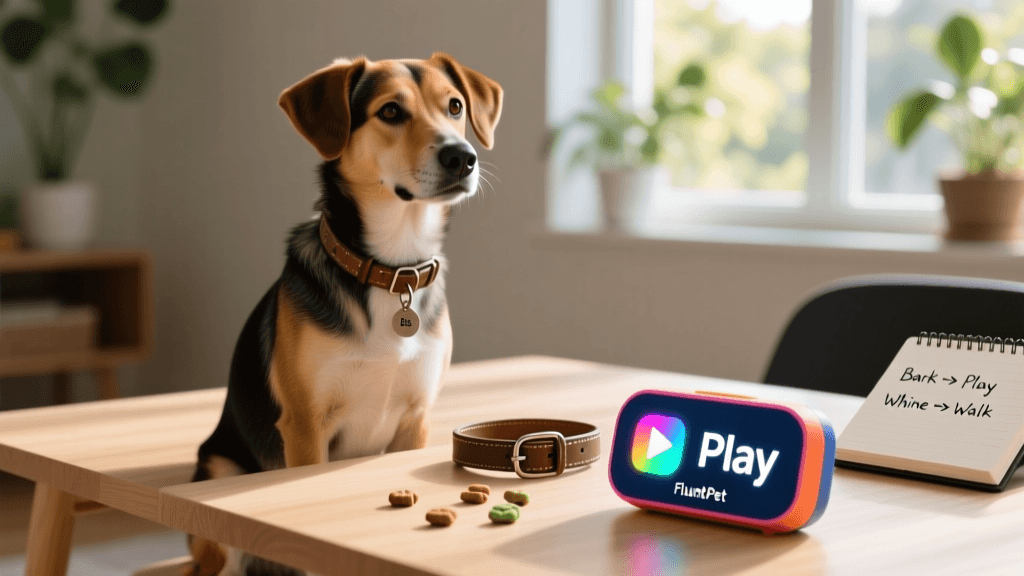
Additionally, pay close attention to turn-taking. If both dogs rush the 'Outside' button, use the opportunity to model 'Wait' or 'Turn'. The FluentPet smart app is particularly useful here, as it can differentiate between the micro-chipped collar tags or specific RFID bands worn by each dog, allowing you to track which dog is actually initiating the communication.
Troubleshooting: The 'Spamming' Phase and Button Fatigue
Almost every dog goes through a 'spamming' phase where they press a button repeatedly, sometimes dozens of times in a row. Owners often interpret this as the button breaking or the dog demanding endless treats. In reality, this is often a form of vocalization or a sign of under-stimulation. If your dog spams the 'Play' button, they may not just want a game of fetch; they may be expressing general boredom or a need for mental enrichment.
Conversely, 'button fatigue' occurs when owners fail to respond to the dog's requests, leading the dog to abandon the system entirely. If your dog presses 'Outside' and you are busy working, you must still acknowledge the communication. Say, 'I hear you, we will go outside in five minutes,' and set a timer. Honoring their requests, even on a slight delay, builds trust and reinforces the utility of the AAC system.
Decoding the Micro-Signals Alongside AAC
Sound buttons do not replace the need to read your dog's physical signals; they complement them. A dog might press the 'Play' button because they have learned it results in attention, but if their body is stiff, their ears are pinned back, and they are exhibiting whale eye, they are actually experiencing stress, not joy. In these moments, the owner must prioritize the body language over the button press. The ultimate goal of canine AAC in 2026 is not to turn dogs into furry humans, but to bridge the interspecies gap, giving them a voice while we continue to listen to their bodies.
Final Thoughts on Canine Communication
Investing in an AAC system like the FluentPet Smart HexTiles requires a commitment of time, consistency, and an open mind. You will likely encounter moments of frustration, confusion, and hilarity as your dog discovers new ways to express their inner world. However, the payoff—a deeper, more empathetic bond with your canine companion—is immeasurable. By combining modern technology with a profound respect for canine cognition, we are finally giving our best friends the tools they need to tell us exactly what they have been trying to say all along.
anouk-beaumont
All our authors care for dogs every day — read more of their work on the authors page.