Best Family Dog Breeds for Toddlers and Safety Prep
Discover the best dog breeds for families with toddlers, plus expert home safety prep, baby gate recommendations, and tips for peaceful coexistence.

Welcoming a Dog into a Home with Toddlers
Bringing a new dog into a household with toddlers is a magical milestone that promises a lifetime of companionship, laughter, and unforgettable memories. However, the intersection of puppy energy and toddler unpredictability requires careful planning, immense patience, and strategic home preparation. Toddlers are naturally uncoordinated, loud, and prone to sudden movements, which can startle or overwhelm an unprepared dog. Conversely, a rambunctious dog can accidentally knock over a small child during play. As a senior dog care specialist, I always advise parents that the secret to a harmonious multi-species household lies in selecting the right breed temperament and rigorously dog-proofing your living spaces before paws ever touch your floors.
Top Dog Breeds for Families with Toddlers
When selecting a breed to live alongside toddlers, temperament, sturdiness, and patience are paramount. You want a dog that is forgiving of clumsy petting, resilient enough to handle a bustling household, and eager to please. According to breed standards and behavioral experts, the following breeds consistently rank at the top for families with young children.
| Breed | Avg Weight | Energy Level | Grooming Needs | Toddler Suitability |
|---|---|---|---|---|
| Golden Retriever | 55-75 lbs | Moderate-High | High (Weekly brushing) | Excellent |
| Bichon Frise | 12-18 lbs | Moderate | High (Professional grooming) | Very Good |
| Beagle | 20-30 lbs | High | Low (Occasional brushing) | Good |
| Boxer | 50-80 lbs | High | Low (Weekly brushing) | Very Good |
| Labrador Retriever | 55-80 lbs | High | Moderate (Shedding) | Excellent |
Golden Retriever and Labrador Retriever
These retrievers are the gold standard for family dogs. They possess an innate desire to please, high pain tolerance, and a gentle mouth. Their sturdy build means they are less likely to be injured if a toddler accidentally trips over them. However, their high energy levels, especially in the first three years of life, require dedicated daily exercise to prevent boisterous jumping that could topple a toddler.
Bichon Frise
For families wanting a smaller dog, the Bichon Frise is a fantastic choice. Unlike many fragile toy breeds, the Bichon is surprisingly sturdy and playful. They are highly affectionate and adapt well to indoor living. The trade-off is their coat, which requires professional grooming every 4 to 6 weeks, costing approximately $50 to $90 per session.
Beagle
Beagles are sturdy, compact, and incredibly tolerant. Their pack-hound mentality means they thrive in busy, noisy family environments. The main challenge with Beagles is their nose-driven stubbornness and vocalization, requiring patient, treat-based training to manage their baying instincts.
Breeds to Approach with Caution
While every dog is an individual, certain breed groups possess instincts that clash with toddler behavior. Herding breeds like Border Collies and Australian Shepherds may attempt to herd running toddlers by nipping at their heels. Toy breeds like Chihuahuas or Pomeranians are physically fragile; a toddler dropping a toy or falling on them can cause severe injury, leading to defensive biting. Terriers often have high prey drives and low tolerance for having their ears or tails pulled, making them a risky match for children under the age of five.
Preparing Your Home: Safe Zones and Essential Gear
Before bringing your new dog home, you must establish physical boundaries. Both the dog and the toddler need designated safe zones where they can retreat without being bothered by the other.
Baby Gates and Playpens
Invest in high-quality, hardware-mounted baby gates for high-traffic areas like the kitchen and stairs. For doorways, the Regalo Easy Step Walk Thru Gate (approx. $45) is a parent favorite. It fits openings between 29 and 39 inches wide and features a one-touch release safety lock that is easy for adults but impossible for toddlers or clever dogs to manipulate. For creating a temporary, flexible safe zone, the MidWest Homes for Pets Foldable Metal Exercise Playpen (approx. $70 for a 24-inch height, 8-panel setup) is invaluable. You can set this up in the living room to give the dog a secure space to chew a bone while the toddler plays freely nearby.
Creating a Canine Sanctuary
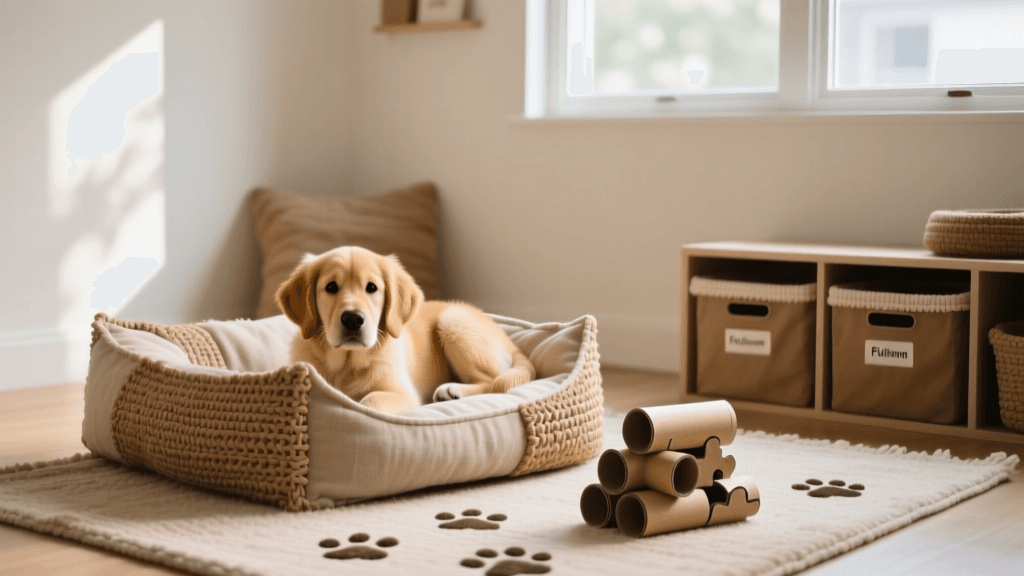
Your dog needs a toddler-free zone. Set up a sturdy wire crate or a cozy corner in a low-traffic room (like a home office or guest room) with an orthopedic bed. Teach your toddler from day one that when the dog is in their bed or crate, they are invisible. This prevents the dog from feeling cornered and reduces the risk of resource guarding.
Teaching Toddlers and Recognizing Canine Stress
According to the American Veterinary Medical Association (AVMA), the majority of dog bites to children occur in the home, often involving a familiar dog and a lack of adult supervision. The AVMA emphasizes that educating children on how to read canine body language and interact safely is the most critical step in bite prevention.
Furthermore, the American Academy of Pediatrics, via HealthyChildren.org, stresses that infants and toddlers should never be left alone with a pet, even for a few seconds. Supervision must be active, meaning your eyes are on the interaction, not on your smartphone.
The Pet, Pet, Pause Method
Teach your toddler the 'Pet, Pet, Pause' method. Show them how to gently stroke the dog's back (never the top of the head or face) for three seconds, then pause and pull their hands away. If the dog leans in or nudges them, the dog is consenting to more pets. If the dog turns away, licks its lips, or walks off, the toddler must respect the boundary. Recognizing early stress signals—such as 'whale eye' (showing the whites of the eyes), yawning when not tired, or stiffening of the body—allows parents to intervene before a dog feels the need to growl or snap.
First-Day Essentials for a Smooth Transition
To ensure the first few weeks are as peaceful as possible, stock up on these specific enrichment and management tools:
- KONG Classic Dog Toy (Red or Black): Fill this with peanut butter (xylitol-free) and freeze it. A frozen KONG can occupy a dog for 30 to 45 minutes, providing a crucial window for you to focus entirely on your toddler without a dog demanding attention.
- Snuffle Mat for Foraging: Sprinkle your dog's kibble into the fabric strips of a snuffle mat. This mimics natural foraging behavior, tires out their brain, and keeps them quietly occupied on the floor.
- White Noise Machine: Toddlers scream, cry, and drop heavy wooden blocks. A white noise machine placed near the dog's sanctuary helps muffle sudden, sharp household noises that might trigger anxiety or barking.
- Enzymatic Cleaner (e.g., Nature's Miracle): Accidents will happen, especially if the dog is stressed by the new environment. Enzymatic cleaners break down uric acid crystals, preventing the dog from returning to the same spot to soil again.
Final Thoughts on Building a Lifelong Bond
Integrating a dog into a family with toddlers is not a passive process; it is an active, daily practice of management, training, and empathy. As highlighted by the American Kennel Club (AKC), the best family dogs are not just born; they are raised through consistent socialization, positive reinforcement, and structured routines. By choosing a breed that matches your family's lifestyle, investing in the right safety gates and enrichment tools, and actively teaching your toddler how to respect canine boundaries, you are laying the groundwork for a beautiful, lifelong friendship between your child and their new best friend.
beth-carrasco
All our authors care for dogs every day — read more of their work on the authors page.