Engage-Disengage Game and Adaptil Calm Collar for Reactive Dogs 2026
Master leash reactivity in 2026 with the Engage-Disengage game and Adaptil Calm Collar. Expert steps, gear guides, and threshold tips for anxious dogs.
The Modern Landscape of Leash Reactivity in 2026
As we navigate the dog ownership landscape in 2026, veterinary behaviorists and certified trainers are seeing a sustained prevalence of leash reactivity. Whether stemming from inadequate early socialization, genetic predispositions, or traumatic experiences, reactivity manifests as barking, lunging, and extreme anxiety when a dog encounters triggers like other dogs, strangers, or unfamiliar noises. It is crucial to understand that reactivity is rarely rooted in malice; rather, it is an emotional response driven by fear, frustration, or over-arousal. According to the ASPCA, many dogs labeled as 'aggressive' on walks are actually displaying fear-based reactivity, attempting to increase the distance between themselves and the perceived threat.
Managing a reactive dog requires a multi-faceted approach that combines behavioral modification, environmental management, and physiological support. In 2026, the gold standard for behavioral modification remains the Engage-Disengage game, a protocol rooted in classical counterconditioning and operant learning. When paired with modern pheromone therapy like the Adaptil Calm Collar, owners can significantly lower their dog's baseline anxiety, making the learning process more effective and humane.
The Science Behind the Engage-Disengage Game
Originally developed by Leslie McDevitt in her seminal 'Control Unleashed' program, the Engage-Disengage game is a powerful desensitization and counterconditioning (DSCC) technique. The core objective is to change the dog's emotional response to a trigger. Instead of the trigger predicting a stressful encounter, the trigger becomes a cue that predicts high-value rewards. VCA Animal Hospitals emphasizes that successful DSCC requires keeping the dog 'sub-threshold'—meaning the dog notices the trigger but is not so overwhelmed that they enter a fight-or-flight state. If a dog is over threshold, the learning centers of the brain shut down, and no behavioral modification can occur.
The game is divided into two distinct phases. Phase One relies purely on classical conditioning (the trigger appears, and a treat follows, regardless of the dog's behavior). Phase Two introduces an operant component, where the dog is rewarded for voluntarily choosing to look away from the trigger and engage with the handler. This voluntary disengagement is a massive breakthrough for anxious dogs, as it gives them agency and a coping mechanism in stressful environments.
Step-by-Step: Playing the Engage-Disengage Game
To implement this protocol effectively in 2026, you will need a clicker or a consistent marker word (like 'Yes!'), a stash of ultra-high-value treats (such as boiled chicken, freeze-dried liver, or string cheese), and a safe environment where you can control the distance to the trigger.
Phase One: Classical Conditioning (Engage)
- Step 1: Find your dog's threshold distance. This is the distance at which your dog notices the trigger (e.g., another dog) but remains calm enough to eat a treat and respond to your voice.
- Step 2: The moment your dog looks at the trigger, mark the behavior with a click or your marker word.
- Step 3: Immediately deliver a high-value treat. The sequence is: Dog looks at trigger -> Click -> Treat.
- Step 4: Repeat this process. You are not asking the dog to do anything other than notice the trigger. You are rewiring their brain to associate the sight of the trigger with a positive outcome.
Phase Two: Operant Conditioning (Disengage)
- Step 1: Once your dog reliably looks at the trigger and then immediately whips their head back toward you in anticipation of the treat, you are ready for Phase Two.
- Step 2: When your dog looks at the trigger, wait for a count of three seconds. Do not click immediately.
- Step 3: If your dog voluntarily disengages (turns their head away from the trigger to look at you) within those three seconds, click and reward heavily.
- Step 4: If your dog stares at the trigger for more than three seconds, they are likely too close to the trigger. Increase your distance and revert to Phase One.
Integrating the Adaptil Calm Collar for Neurological Support
Behavioral modification is incredibly demanding on a dog's nervous system. In 2026, the VCA Fear and Anxiety Guide notes that addressing the physiological symptoms of anxiety is just as important as training. The Adaptil Calm Collar utilizes Dog Appeasing Pheromone (DAP), a synthetic replica of the pheromone released by nursing mother dogs to soothe and reassure their puppies.
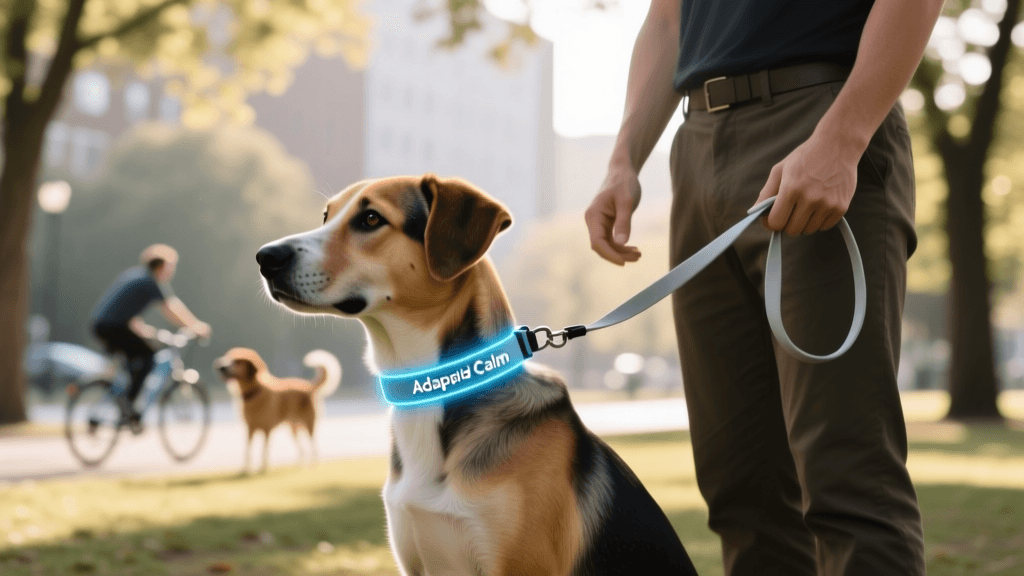
The 2026 iterations of the Adaptil Calm Collar feature an improved sustained-release polymer matrix, ensuring a consistent diffusion of pheromones for up to 45 days, even in varying outdoor temperatures. When a reactive dog wears this collar, the pheromones bind to the vomeronasal organ in the nasal cavity, sending signals to the brain's limbic system to reduce cortisol levels and promote a state of calm. While the collar will not 'cure' reactivity on its own, it lowers the dog's baseline arousal, effectively widening their threshold window and making the Engage-Disengage game significantly more successful.
2026 Essential Gear Comparison for Reactive Dogs
Success in reactive dog management relies heavily on having the right equipment. Below is a comparison of the top recommended gear for 2026, focusing on safety, comfort, and effectiveness for leash-reactive dogs.
| Gear Item | Primary Use | 2026 Top Recommendation | Estimated Price Range |
|---|---|---|---|
| Front-Clip Harness | Reduces pulling leverage and prevents choking during lunging episodes. | Blue-9 Balance Harness (Custom Fit) | $65 - $85 |
| Treat Pouch | Allows for rapid treat delivery without fumbling in pockets. | Ruffwear Treat Trader (Magnetic Closure) | $40 - $55 |
| Calming Collar | Provides continuous pheromone therapy to lower baseline anxiety. | Adaptil Calm On-the-Go Collar (2026 Formula) | $25 - $35 |
| Long Line | Provides safe decompression and distance management on walks. | Biothane Waterproof Long Line (15ft - 30ft) | $30 - $60 |
Troubleshooting Threshold Breaches
Even with meticulous planning, threshold breaches will happen. A neighbor's dog might escape a yard, or a loud truck might backfire unexpectedly. When your dog goes over threshold, their amygdala hijacks their brain, and they will likely bark, lunge, and refuse treats. In these moments, abandon the Engage-Disengage game immediately.
Your only goal during a breach is to increase distance. Use an emergency 'Let's Go!' cue, turn 180 degrees, and jog away from the trigger to a safe distance where your dog can shake off the adrenaline. Do not punish the dog for lunging; punishment only adds to their fear and confirms that the trigger is indeed dangerous. Once your dog has decompressed and their heart rate has returned to normal, you can resume training at a much greater distance. Consistent tracking of these breaches in a training journal will help you identify environmental patterns and avoid them in the future.
Long-Term Management and Holistic Wellness
Managing a reactive dog is a marathon, not a sprint. In 2026, holistic wellness approaches are increasingly integrated into behavioral plans. Ensuring your dog receives adequate mental enrichment at home—such as scent work, puzzle feeders, and lick mats—can drastically reduce pent-up energy that often manifests as frustration on walks. Furthermore, consulting with a veterinary nutritionist to ensure your dog's diet supports neurological health, potentially incorporating Omega-3 fatty acids and L-theanine supplements, can provide an additional layer of support.
By combining the structured, science-backed Engage-Disengage game with the physiological calming support of the Adaptil Calm Collar, you are setting your dog up for success. Reactivity is a profound challenge, but with patience, empathy, and the right 2026 protocols, you and your dog can transform your daily walks from a source of dread into an opportunity for connection and growth.
tom-renshaw
All our authors care for dogs every day — read more of their work on the authors page.