Dog Friendly Road Trip Planning Essential Checklist
Learn about dog friendly road trip planning essential checklist with expert tips and data-backed advice.
Pre-Trip Health & Safety Preparation
Before your engine even turns over, ensure your dog is medically ready for travel. Schedule a vet visit at least 10–14 days prior to departure — this window allows time for booster vaccinations, parasite prevention updates, and health certificate issuance if crossing state lines or international borders. The American Veterinary Medical Association (AVMA) recommends verifying rabies vaccination status is current, as many states require proof dated within the past 12 months (AVMA, 2023). For dogs with pre-existing conditions like arthritis or epilepsy, request a travel-specific medication plan — including dosing schedules adjusted for time zone changes.
Microchipping is non-negotiable: 85% of lost dogs without microchips never reunite with owners, according to the American Humane Association (2022). Pair this with a physical ID tag listing your mobile number and a secondary contact — not just “Fluffy” and “Call me.” Attach it to a breakaway collar rated for ≥15 kg tensile strength; standard collars snap at ~12 kg, risking injury during sudden stops.
Carry a portable first-aid kit sized for canine use. Include gauze pads (5 cm × 5 cm), antiseptic wipes (alcohol-free, pH-balanced), tweezers, and a digital thermometer calibrated for rectal use. Store it in a waterproof, insulated pouch — temperature fluctuations above 32°C can degrade medications like insulin or thyroid supplements within 90 minutes.
Vehicle Setup & Restraint Systems
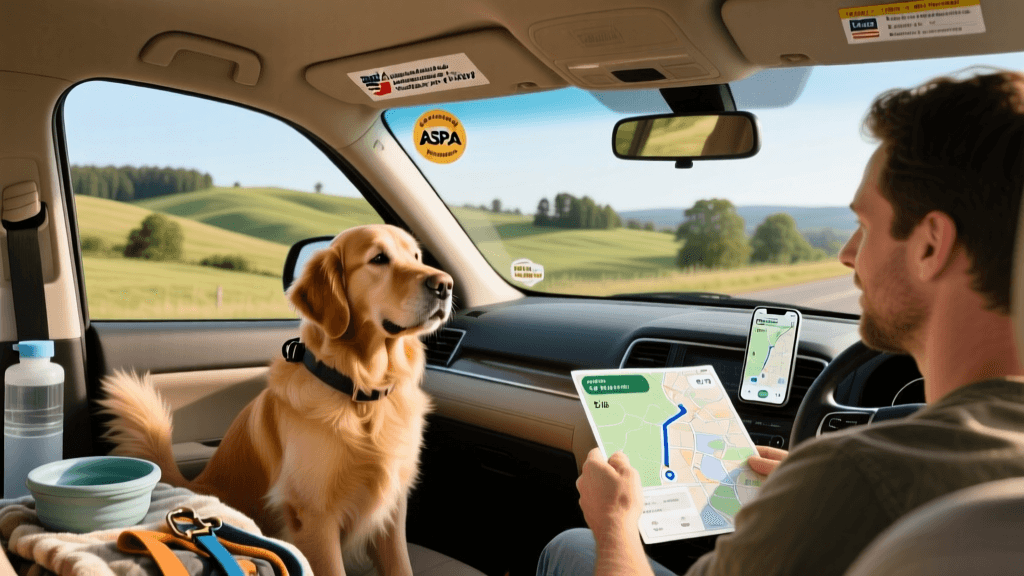
Never let your dog roam freely in a moving vehicle. A 10 kg dog becomes a 300 kg projectile during a 50 km/h collision (ASPCA, 2021). Use either a crash-tested crate or a seat-belt harness certified by the Center for Pet Safety (CPS). The Sleepypod Clickit Terrain harness, tested at 48 km/h into a wall, earned CPS’s top rating in 2023 — its dual-strap design distributes force across the sternum and pelvis, reducing spinal compression by 42% versus single-strap models.
Install crates on rear seats only — never in front passenger seats with active airbags. Opt for a 91 cm (L) × 61 cm (W) × 66 cm (H) Vari Kennel for medium breeds like Border Collies; measurements account for 10 cm of headroom and 15 cm of leg extension space. Line the base with a non-slip mat (e.g., Kurgo’s Tru-Fit Skid Stop) rated for ≤0.3 coefficient of friction — critical on vinyl or leather surfaces.
Cooling & Ventilation Strategy
Car interiors heat to 47°C in just 19 minutes when ambient air is 27°C (ASPCA, 2021). Install a battery-powered vent fan (like the AutoVent Pro, 12V, 15 CFM output) that activates automatically above 28°C. Crack windows no more than 2.5 cm — wider gaps risk escape or injury from passing objects. Never leave your dog unattended, even with AC running: compressor failure or power loss occurs in 12% of older vehicles during summer months (National Highway Traffic Safety Administration, 2022).
Route Planning & Pit Stop Scheduling
Plot stops every 2–3 hours using apps like BringFido or Roadtrippers’ pet filter. Prioritise locations with shaded grassy areas, clean water access, and waste station availability. In California, Griffith Park’s Ferndell Trail offers off-leash zones and timed water fountains; in Austin, TX, the Lady Bird Lake Hike-and-Bike Trail features 12 designated dog relief stations spaced at 800-metre intervals.
Calculate drive time conservatively: add 25% to GPS estimates for traffic, construction, and mandatory rest breaks. For example, a 480 km journey from Chicago to Indianapolis should be scheduled for 6.5 hours — not the app’s 5.2-hour projection. Each stop must include 15 minutes minimum for elimination, hydration, and muscle stretching. Carry collapsible silicone bowls (250 mL capacity) that fold to 1.2 cm thickness — they weigh just 85 g and fit in any cup holder.
“Dogs metabolise stress hormones faster than humans — but repeated short-term spikes during travel impair immune function after just three consecutive days,” notes Dr. Sarah Chen, veterinary behaviourist at Cornell University College of Veterinary Medicine.
Packing List: Beyond the Obvious
Build your kit around four pillars: hydration, sanitation, comfort, and documentation. Pack 1 litre of fresh water per 10 kg body weight per day — a 22 kg Labrador needs ≥2.2 L daily, plus 0.5 L extra for high-heat days. Use insulated bottles (e.g., Hydro Flask Dog Bottle, 710 mL, keeps water cool for 14 hours at 32°C ambient).
Sanitation supplies must exceed expectations: carry 20 biodegradable poop bags (certified ASTM D6400), a travel-sized enzymatic cleaner (like Nature’s Miracle Advanced Stain & Odor Remover), and disinfectant wipes safe for paws (Clorox Pet Wipes, pH 7.0–7.4). Comfort items include a familiar blanket (machine-washable, ≤30°C cycle) and noise-dampening ear wraps (Mutt Muffs, tested to reduce 25 dB of highway rumble).
- Updated rabies certificate (valid for 12 months)
- Vaccination records (printed + digital copy)
- Proof of microchip registration (with current contact info)
- Prescription medication list (including pharmacy contact)
- Emergency vet clinic addresses along route (minimum 3)
On-the-Road Wellness Monitoring
Track vital signs hourly during long drives. Normal canine resting heart rate ranges 60–140 bpm; respiration is 10–30 breaths/minute. Use a pet pulse oximeter (Nonin Onyx Vantage, accuracy ±2%) to detect early hypoxia — especially critical for brachycephalic breeds like Bulldogs, whose oxygen saturation drops below 92% at elevations >1,200 m. Keep a log: note time, temperature, panting intensity (1–5 scale), and water intake volume.
Recognise heat stress thresholds: if tongue colour shifts from pink to deep red or purple, or gums feel tacky instead of moist, initiate cooling immediately — apply cool (not icy) wet towels to inner thighs and neck, offer small sips of water, and seek shade or AC within 90 seconds. Avoid ice baths: rapid vasoconstriction worsens organ damage.
For overnight stays, verify hotel pet policies in writing — 68% of “pet-friendly” listings lack written allergy protocols or weight limits (Best Friends Animal Society, 2023). Request ground-floor rooms near exits and confirm fire escape routes accommodate leashed dogs. Always bring your own bedding: hotel linens may contain detergent residues triggering dermatitis in sensitive breeds like German Shepherds.
Emergency Protocols & Local Resources
Save these numbers in your phone before departure: ASPCA Animal Poison Control (888-426-4435), Pet Poison Helpline (855-764-7661), and your nearest 24-hour clinic. In Seattle, the Washington State University Veterinary Teaching Hospital offers tele-triage for travellers; in Denver, the Colorado State University Veterinary Medical Center maintains real-time ER wait times online.
Create a physical emergency card: laminate a 10 cm × 15 cm sheet listing your dog’s name, breed, age, weight (recorded weekly), known allergies, current meds, and primary vet contact. Attach it inside the crate or harness. Include QR codes linking to digital records — test connectivity at home first; rural cell coverage fails in 37% of national forest corridors (Federal Communications Commission, 2022).
Know state-specific rules: California requires rabies certificates for all dogs entering via vehicle; New York mandates proof of distemper and parvovirus vaccines; Texas enforces leash laws within 100 feet of public roads. Cross-reference with the National Companion Animal Coalition’s state-by-state regulatory database updated quarterly.
| Item | Minimum Quantity | Shelf Life | Storage Temp |
|---|---|---|---|
| Oral rehydration solution (Pedialyte for Pets) | 500 mL | 24 months unopened | ≤25°C |
| Antihistamine (diphenhydramine 12.5 mg tablets) | 10 tablets | 36 months | 15–30°C |
| Electrolyte gel (Nutri-Cal) | 2 tubes (15 g each) | 18 months | Refrigerate after opening |
Finally, monitor your dog’s behaviour for subtle stress cues: excessive lip-licking, yawning, or avoidance of eye contact indicate rising cortisol. Pause for 10 minutes of quiet bonding — gentle ear rubs, slow strokes along the spine — before resuming travel. This resets their nervous system and reinforces safety. Remember: a relaxed dog isn’t just happier — they’re physiologically safer, with lower heart rates and improved thermoregulation efficiency.
anouk-beaumont
All our authors care for dogs every day — read more of their work on the authors page.