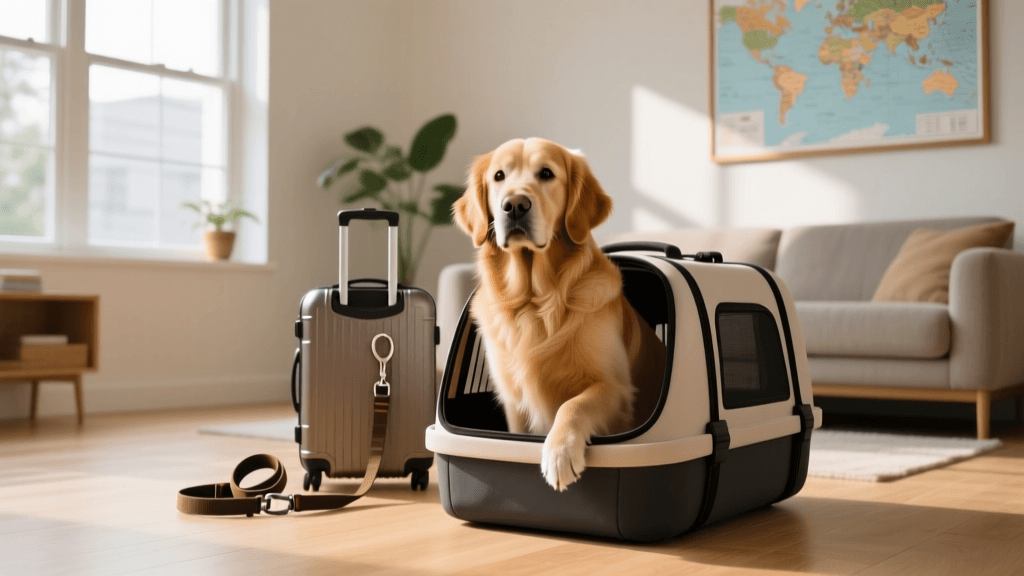
Dog Car Harness vs Crate: Which Travel Option is Safest?
Discover the ultimate side-by-side comparison of dog car harnesses vs. crash-tested crates. Learn which travel safety option is best for your furry friend.
The Hidden Danger of Unrestrained Pet Travel
When you buckle up for a road trip or a quick drive to the grocery store, you likely do not think twice about your own safety. But what about your dog? A common misconception among pet owners is that a dog sitting on the backseat or resting in the cargo area is perfectly safe. In reality, an unrestrained dog in a moving vehicle is a significant safety hazard, not just to themselves, but to every human passenger in the car.
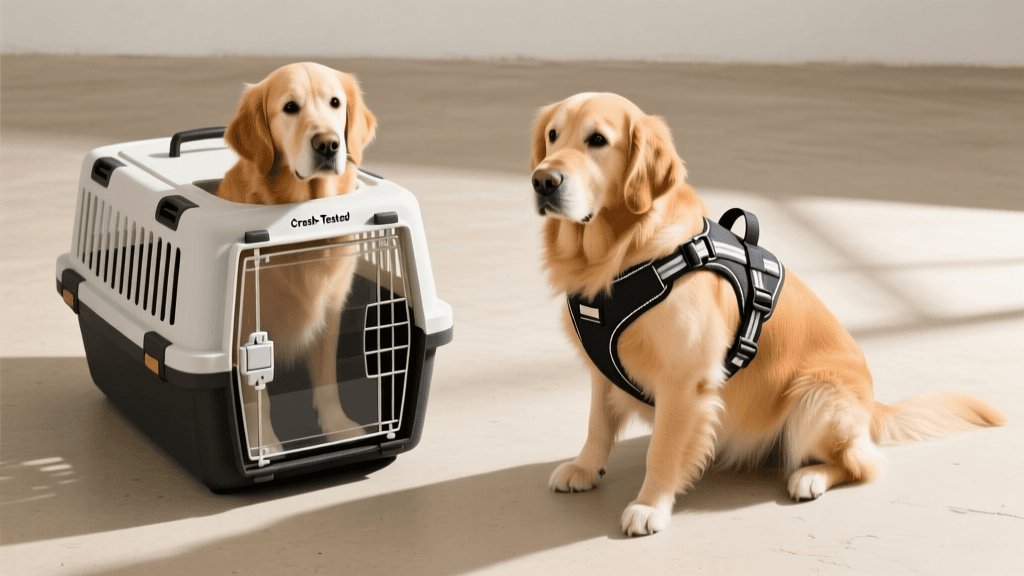
In the event of a sudden stop or a collision, an unrestrained pet becomes a dangerous projectile. According to safety experts, an unrestrained 50-pound dog in a 30 mph crash generates roughly 1,500 pounds of projectile force. This devastating physics equation is why securing your dog is non-negotiable. However, when it comes to choosing the right restraint system, pet owners are generally torn between two primary options: a crash-tested dog car harness or a crash-tested travel crate. Both offer distinct advantages, but they function very differently in a crash and suit different types of dogs, vehicles, and travel routines.
In this comprehensive side-by-side comparison, we will break down the science, the costs, and the practical daily use of dog car harnesses versus travel crates to help you make the most informed decision for your furry co-pilot.
Contender 1: Crash-Tested Dog Car Harnesses
A dog car harness is designed to mimic the safety mechanics of a human seatbelt. It wraps around your dog's chest and shoulders, distributing the kinetic energy of a sudden stop across the strongest parts of their body. It is crucial to note the distinction between a 'walking harness' with a seatbelt loop and a genuinely 'crash-tested harness.' Only harnesses that have undergone rigorous dynamic crash testing at independent facilities should be trusted in a vehicle.
Top-tier products like the Sleepypod Clickit Sport and the Kurgo Tru-Fit Enhanced Strength Harness are engineered with automotive-grade seatbelt webbing and heavy-duty steel buckles. These harnesses connect directly to your vehicle's existing seatbelt system or LATCH anchors, keeping the dog secured in the back seat.
Pros and Cons of Car Harnesses
- Pros: Highly space-efficient; ideal for sedans and smaller vehicles; generally more affordable (ranging from $70 to $120); allows the dog to sit, lie down, and look out the window comfortably; excellent for dogs who experience claustrophobia.
- Pros: Easy to store when not in use; doubles as a secure walking harness at rest stops.
- Cons: Requires precise fitting (measuring neck and chest girth); dogs can still be thrown forward slightly before the tether catches; does not contain the dog if they experience motion sickness and vomit; not ideal for the cargo area of SUVs unless specific anchor points are used.
Contender 2: Crash-Tested Dog Travel Crates
For maximum protection, a crash-tested travel crate is widely considered the gold standard. Unlike standard wire or plastic airline crates, which can shatter or collapse upon impact, crash-tested crates are constructed from rotomolded plastics, reinforced aluminum, or energy-absorbing foam. They are designed to act as a survival cell, utilizing crumple zones to dissipate crash forces away from the dog.
Premium brands like Gunner Kennels (G1) and Ruff Land Performance Kennels are engineered to withstand extreme impacts. These crates are typically placed in the cargo area of an SUV or minivan and must be securely strapped down using heavy-duty ratchet straps tied to the vehicle's cargo tie-down hooks.
Pros and Cons of Travel Crates
- Pros: Unmatched structural protection; fully contains the dog (and any motion sickness messes); provides a familiar, den-like environment that reduces anxiety for many dogs; keeps the dog safely separated from the passenger cabin.
- Cons: Highly expensive (ranging from $400 to $800+); extremely bulky and heavy, taking up significant cargo space; requires a vehicle with adequate cargo dimensions and tie-down anchors; not easily transferable between different vehicles.
Side-by-Side Comparison: Harness vs. Crate
To help visualize how these two safety systems stack up against each other, review the comparison chart below:
| Feature | Crash-Tested Harness | Crash-Tested Crate |
|---|---|---|
| Average Cost | $70 - $120 | $400 - $800+ |
| Ideal Vehicle Type | Sedans, Coupes, Small Crossovers | SUVs, Minivans, Trucks, Station Wagons |
| Setup Time | 1 - 2 minutes (buckling in) | 5 - 10 minutes (strapping down) |
| Space Required | Minimal (uses existing backseat) | Maximum (occupies most of the cargo area) |
| Mess Containment | Poor (vomit/hair stays on seats) | Excellent (contained within the kennel) |
| Multi-Dog Travel | Difficult (dogs may tangle or crowd) | Excellent (each dog gets a separate, safe zone) |
The Science of Pet Travel Safety
Understanding the physics of a car crash is vital when evaluating these products. The Center for Pet Safety, a leading independent research and advocacy organization, has conducted extensive crash tests on both harnesses and crates. Their data reveals that many commercial products marketed as 'safe' fail catastrophically under dynamic crash conditions, with buckles snapping and plastic shattering. This is why looking for independent safety certifications is critical.
Furthermore, the American Kennel Club emphasizes that securing your dog is not just about protecting the pet; it is about protecting the driver. A loose dog in the cabin is a major distraction and can interfere with steering, braking, or airbag deployment. By utilizing a properly rated harness or crate, you ensure that the kinetic energy of your dog is managed by the vehicle's structural safety systems rather than the fragile bodies of your human passengers.
Remember: A pet restraint system is only as strong as its weakest link. A $500 crash-tested crate is useless if it is not properly strapped down to the vehicle's chassis using rated tie-down straps.
How to Choose the Right Option for Your Dog
The decision between a harness and a crate ultimately comes down to three practical factors: your vehicle, your dog's physical dimensions, and your dog's temperament.
1. Consider Your Vehicle Type and Cargo Space
If you drive a standard sedan or a compact hatchback, a crash-tested crate is likely not an option. The sloping roofline and limited cargo depth will not accommodate a properly sized crate. In this scenario, a high-quality harness like the Sleepypod Clickit Sport, used in the back seat with the seatbelt routed through the designated loops, is your safest and most practical choice. Conversely, if you drive a mid-size or full-size SUV, a crate placed in the rear cargo area (ideally against the back of the rear seats to prevent excessive forward momentum) offers superior protection.
2. Measure Your Dog Accurately
For harnesses, you must measure your dog's neck circumference and the widest part of their chest girth. A harness that is too loose will allow the dog to slip out or suffer whiplash, while one that is too tight will restrict breathing. For crates, the rule of thumb is that your dog should be able to stand up without their head touching the top, and turn around comfortably. Add roughly two inches to their standing height and four to six inches to their length when selecting a crate size. However, in a crash scenario, a crate that is too large is dangerous, as it gives the dog too much room to be thrown around inside the kennel.
3. Evaluate Temperament and Motion Sickness
Dogs who suffer from severe travel anxiety often do better in a crate. The enclosed, den-like space provides a psychological barrier against the visual overstimulation of passing cars. Additionally, if your dog is prone to car sickness, a crate is infinitely easier to clean. You can line the bottom of a rotomolded crate with absorbent puppy pads and simply hose it out at your destination. Cleaning vomit out of the crevices of a backseat and a complex harness webbing system is a frustrating experience that many pet owners wish to avoid.
Final Verdict: Which is Better?
There is no universal 'best' option; there is only the best option for your specific situation. If you have the budget, drive a spacious SUV, and want the absolute highest level of structural protection and mess containment, a crash-tested travel crate properly secured with ratchet straps is the undisputed champion of pet travel safety.
However, if you drive a smaller vehicle, are on a stricter budget, or have a dog who panics when enclosed, a certified crash-tested car harness is a highly effective, safe, and practical alternative. Whichever route you choose, the most important step is ensuring that the product you purchase has verifiable, independent crash-test data. Never compromise on your dog's safety for the sake of convenience or a lower price tag. Safe travels!
marcus-aldridge
All our authors care for dogs every day — read more of their work on the authors page.