2026 Canine OA Treatment: Home Setup & Librela Guide
Discover the latest 2026 canine OA treatments, including Librela injections, and learn how to modify your home for your arthritic dog's comfort.
The Evolution of Canine Osteoarthritis Care in 2026
Living with a dog suffering from osteoarthritis (OA) requires a multifaceted approach that goes far beyond simply administering pain medication. As we navigate 2026, the veterinary landscape has shifted dramatically toward targeted biologic therapies and comprehensive environmental modifications. Canine OA is a degenerative joint disease that affects an estimated 20% to 25% of adult dogs, and the focus of modern treatment is no longer just about masking pain—it is about preserving joint function, targeting nerve growth factors, and optimizing the home environment to maintain your dog's quality of life.
According to the American Kennel Club's canine health guidelines, early intervention and continuous environmental management are the cornerstones of slowing OA progression. In this guide, we will explore the most effective 2026 canine OA treatments, specifically the widespread use of anti-NGF monoclonal antibodies like Librela, and provide actionable steps to modify your home for an arthritic dog.
Targeting the Source: Librela and Anti-NGF Therapy
For years, Non-Steroidal Anti-Inflammatory Drugs (NSAIDs) were the undisputed first-line treatment for canine OA. While NSAIDs like carprofen and meloxicam remain valuable tools, 2026 veterinary consensus heavily favors the integration of monoclonal antibodies for long-term management. Librela (bedinvetmab) has revolutionized canine OA treatment by specifically targeting Nerve Growth Factor (NGF), a protein that plays a critical role in the transmission of pain signals in arthritic joints.
Unlike traditional NSAIDs, which are metabolized by the liver and kidneys and can cause gastrointestinal or renal side effects with prolonged use, Librela is a caninized monoclonal antibody. It is designed to bind to NGF, neutralizing it before it can amplify pain signals. This makes it an exceptionally safe option for senior dogs who may already have compromised kidney or liver function, a common scenario in multi-pet households managing aging companions.
2026 OA Medication Comparison Chart
Below is a comparison of the most common OA treatments prescribed by veterinarians in 2026. Always consult your vet before starting or changing any medication protocol.
| Treatment | Drug Class | Administration | 2026 Est. Monthly Cost | Primary Considerations |
|---|---|---|---|---|
| Librela (bedinvetmab) | Anti-NGF Monoclonal Antibody | Subcutaneous injection (Monthly at vet) | $75 - $150 (weight-dependent) | Minimal liver/kidney impact; highly effective for chronic pain. |
| Carprofen (Rimadyl) | NSAID | Oral chew/tablet (Daily) | $40 - $90 | Requires annual bloodwork to monitor liver and kidney enzymes. |
| Gabapentin | Neuromodulator | Oral capsule/liquid (2-3 times daily) | $20 - $50 | Best for nerve-related pain; can cause mild sedation. |
| Adequan Canine | Polysulfated Glycosaminoglycan | Intramuscular injection (Series, then maintenance) | $60 - $120 | Disease-modifying; helps inhibit cartilage breakdown. |
Essential Home Modifications for the Arthritic Dog
Medication is only half the battle. The Cornell University Riney Canine Health Center emphasizes that environmental modification is critical for reducing the mechanical stress on degenerating joints. Adapting your living space in 2026 involves specific, measurable adjustments to your home's layout and accessories.
1. Traction and Flooring Solutions
Slippery hardwood, tile, and laminate floors are the enemy of arthritic dogs. When a dog's paws slip, the micro-adjustments their muscles and joints must make to stabilize can cause severe pain spikes and accelerate joint deterioration.
- Interlocking Foam Tiles: High-density EVA foam tiles (at least 12mm thick) provide excellent shock absorption and grip. Place them in high-traffic areas and where your dog sleeps.
- Low-Pile Runners: Use non-slip rug runners with a rubberized backing. Ensure the pile is low enough that your dog's nails do not catch in the fibers, which could lead to a torn nail or a sudden fall.
- Paw Balms and Grips: Apply a high-quality paw wax weekly to hydrate cracked pads, or use silicone paw grips for indoor traction.
2. Ramps and Stairs
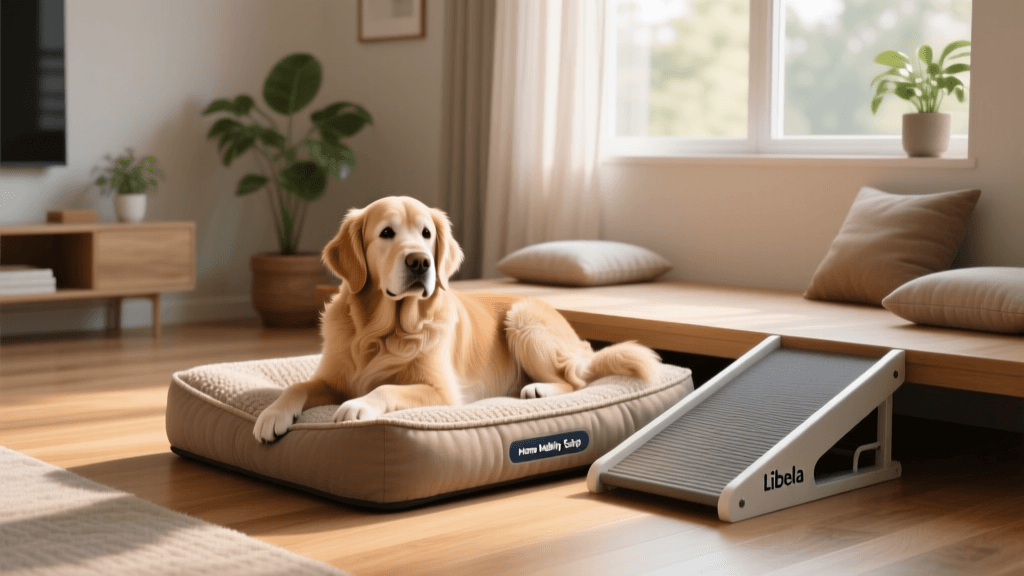
Jumping on and off furniture or navigating steep stairs places immense force on the hips, knees, and shoulders. In 2026, veterinary orthopedic specialists recommend replacing jumps with ramps that meet specific incline criteria.
- The 18-Degree Rule: A ramp's incline should ideally be no steeper than 18 to 20 degrees. For a couch that is 18 inches high, your ramp needs to be at least 54 inches long to achieve a safe, gentle slope.
- Surface Grip: Look for ramps covered in high-traction, ribbed carpet or artificial turf. Avoid plastic surfaces that can become slick.
- Side Rails: For dogs with neurological deficits alongside OA, ramps with raised side rails prevent accidental step-offs and provide a physical boundary that reduces anxiety.
3. Orthopedic Sleep Stations
An arthritic dog needs a bed that prevents their joints from pressing against the hard floor while providing enough support to make standing up easy. Fluffy, overstuffed polyester beds are useless for OA.
- High-Density Memory Foam: Look for beds with a minimum of 4 to 6 inches of high-density, medical-grade memory foam. This material contours to the dog's body, distributing weight evenly and relieving pressure points on the elbows and hips.
- Bolstered Edges: Beds with firm, low bolsters give your dog a place to rest their head and provide a physical anchor they can push against when trying to stand up from a lying position.
- Heated Options: In colder months, low-voltage, chew-resistant heated beds or microwavable heating pads can increase local blood flow and reduce morning joint stiffness.
Adjusting Your Daily Routine and Exercise
Exercise remains vital for maintaining muscle mass, which acts as the primary shock absorber for arthritic joints. However, the type of exercise must change. Long, repetitive runs or high-impact fetch sessions should be replaced with controlled, low-impact activities.
Sniffaris and Mental Enrichment
A 20-minute 'Sniffari'—a slow, meandering walk where the dog is allowed to stop and sniff every tree and bush—provides immense mental stimulation and low-impact physical movement. Sniffing lowers a dog's heart rate and reduces stress. Supplement physical walks with indoor enrichment:
- Snuffle Mats and Lick Mats: These encourage foraging behaviors without requiring the dog to stand or move around excessively.
- Scatter Feeding: Tossing kibble onto your non-slip foam tiles encourages gentle, controlled movement and engages the dog's natural scavenging instincts.
Hydrotherapy and Controlled Movement
If accessible, canine hydrotherapy is one of the most effective 2026 treatments for OA. The buoyancy of the water supports the dog's weight, removing impact stress from the joints, while the water's resistance builds crucial stabilizing muscles. Underwater treadmills are particularly effective for dogs with hip dysplasia or severe stifle (knee) osteoarthritis.
Diet, Weight Management, and Joint Supplements
You cannot out-medicate a poor diet or excess weight. Every extra pound of body weight places roughly four pounds of additional mechanical stress on a dog's joints. Maintaining a lean body condition score (BCS of 4 out of 9) is arguably the single most effective non-pharmaceutical OA treatment available.
Targeted Supplementation
In 2026, veterinary nutritionists recommend specific, evidence-backed supplements to support joint health and reduce systemic inflammation:
- Omega-3 Fatty Acids (EPA and DHA): Sourced from wild-caught Alaskan salmon or green-lipped mussels, high doses of EPA/DHA disrupt the inflammatory cascade in the joints. Look for supplements that guarantee at least 1,000 mg of combined EPA/DHA per day for a 50 lb dog.
- Green-Lipped Mussel (GLM): GLM contains a unique profile of glycosaminoglycans (GAGs) and antioxidants that support cartilage matrix health.
- Undenatured Type II Collagen (UC-II): This supplement works via oral tolerance, modulating the immune system to prevent it from attacking the dog's own joint cartilage.
Monitoring Your Dog's Quality of Life
Because dogs are stoic and rarely vocalize chronic pain, it is up to the owner to track subtle behavioral changes. Utilize standardized tools like the Liverpool Osteoarthritis in Dogs (LOAD) questionnaire, which can be easily found online and filled out monthly. Track metrics such as your dog's willingness to jump into the car, their stiffness after resting, and their overall playfulness. By combining modern biologic treatments like Librela with meticulous home modifications and weight management, you can ensure your senior dog remains comfortable, mobile, and happy throughout their golden years.
jonas-cole
All our authors care for dogs every day — read more of their work on the authors page.