2026 Guide: Train Your Dog to Use Communication Buttons
Learn how to train your dog to use communication buttons in 2026. Master canine AAC, decode body signals, and build a reliable talking board.
The Evolution of Canine AAC in 2026
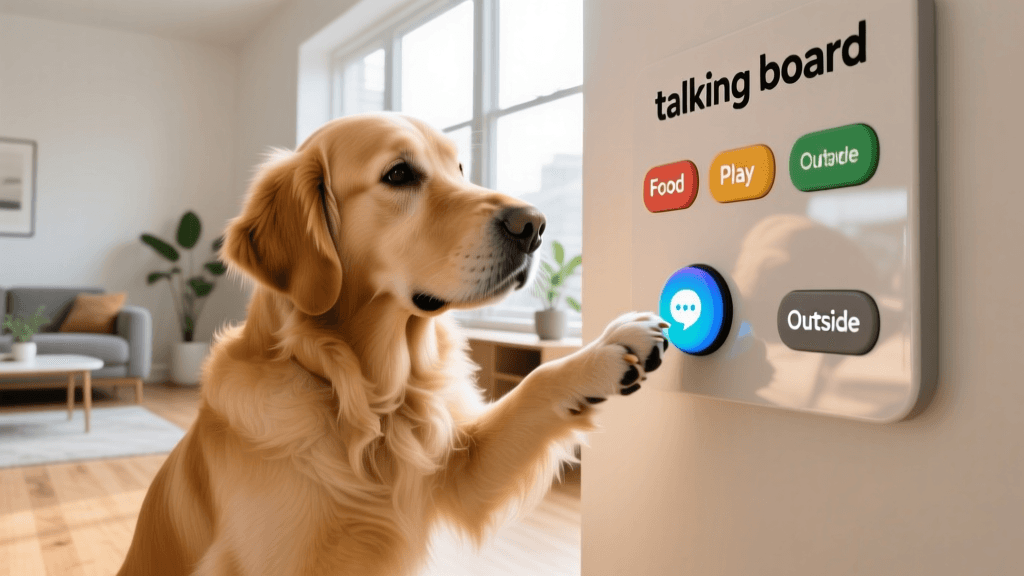
Augmentative and Alternative Communication (AAC) has completely transformed the way we interact with our canine companions. In 2026, teaching dogs to use sound buttons is no longer just a viral internet trend; it is a scientifically backed training methodology that bridges the gap between human language and canine cognition. By leveraging the principles of operant conditioning and behavioral shaping, pet parents can give their dogs a functional vocabulary to express their needs, desires, and even emotional states. According to ongoing research highlighted by the Duke Canine Cognition Center, dogs possess an extraordinary ability to map human symbols and sounds to specific environmental outcomes, making them ideal candidates for AAC training when approached with patience and structured protocols.
Decoding Natural Canine Signals Before Button Training
Before you introduce a talking board, it is crucial to understand how your dog already communicates. Dogs are masters of body language, utilizing a complex array of calming signals, displacement behaviors, and appeasement gestures to navigate their world. When a dog is overwhelmed or needs space, they might exhibit lip licking, yawning, whale eye, or a sudden bout of ground sniffing. These are natural canine signals that indicate stress or a desire to disengage.
Button training should never override or ignore these natural signals. In fact, the most successful AAC dogs are those whose handlers actively acknowledge their natural body language. If your dog offers a play bow, that is the perfect moment to introduce the "Play" button. If they scratch at the door and whine, that is your cue to model the "Outside" button. By pairing your dog's innate communication signals with a tactile button press, you create a clear, associative bridge that makes the learning process significantly faster and more intuitive for the dog.
Furthermore, recognizing displacement signals is critical. If your dog approaches the button board but suddenly stops to scratch their ear, shake off, or sniff the ground intensely, they are communicating cognitive overload. These displacement behaviors indicate that the training session has become too difficult or frustrating. When you see these signals, the best course of action is to immediately lower your criteria, offer a simple, highly reinforced trick they already know, and end the session on a positive note. Pushing a dog past their threshold of cognitive fatigue will only create negative associations with the AAC board.
2026 Equipment Guide: Smart Boards vs. Traditional Mats
The market for canine AAC equipment has matured significantly by 2026. Early iterations of recordable buttons often suffered from poor audio quality, low battery life, and easily lost components. Today's market offers integrated smart mats that track press frequency, time of day, and vocabulary expansion via companion smartphone apps. Below is a comparison of the top dog communication button systems available this year.
| Brand | 2026 Model | Smart Features | Price (Approx.) |
|---|---|---|---|
| FluentPet | HexTile Smart Hub | App tracking, Bluetooth, modular hex tiles | $169.00 |
| Hunger for Words | Talking Mat Pro | Velcro grip mat, high-fidelity recordable lids | $129.00 |
| TalkDoggo | Eco-Board 2026 | Solar-charged base, basic press logging | $89.00 |
For beginners, we highly recommend starting with a 6-to-10 button starter kit rather than overwhelming your dog with a 40-button board on day one. The modular nature of the 2026 HexTile systems allows you to organically grow your dog's vocabulary as their cognitive mapping skills develop.
Step-by-Step Shaping Protocol for Core Vocabulary
Training a dog to use AAC buttons requires a methodical approach rooted in positive reinforcement. The American Kennel Club Training Resources emphasize that marker-based training (using a clicker or a consistent marker word like "Yes!") is essential for capturing the exact moment the dog performs the desired behavior. Here is the definitive 2026 shaping protocol for teaching your first button.
Phase 1: Targeting the Lid
Before the button is even placed on the mat, remove the recordable lid. Hold it in your hand and wait for your dog to investigate. The moment their nose touches the lid, mark the behavior with your clicker and deliver a high-value treat. Repeat this until your dog is confidently and rapidly bumping the lid with their nose or paw. This builds a strong history of reinforcement with the physical object.
Phase 2: Adding the Auditory Cue
Record your chosen word (e.g., "Outside") using a clear, enthusiastic tone. Place the lid back on the button base. When your dog presses the button and the word plays, immediately mark and reward. At this stage, you are teaching the dog that pressing the object produces a sound, and that sound predicts a reward. Do not worry about the context of the word yet; focus purely on the mechanical action of pressing.
Phase 3: Contextual Pairing and Modeling
Now, move the button to its permanent location near the relevant environmental trigger (e.g., next to the back door for "Outside"). Begin modeling the behavior. Every single time you take the dog outside, point to the button, press it yourself so it says "Outside," and then immediately open the door. You are acting as the communication bridge. Eventually, your dog will anticipate the door opening and will press the button themselves to initiate the sequence. When they do, celebrate with a "jackpot" reward—multiple treats and enthusiastic praise.
Phase 4: Expanding the Vocabulary
Once your dog has mastered their first button and is using it reliably in context, you can introduce a second button. It is vital to choose a second word that represents a distinctly different outcome. For example, if your first button was "Outside," make your second button "Water" or "Play." Avoid introducing visually or phonetically similar concepts early on, as this can cause cognitive mapping errors. Place the new button a few inches away from the first, and repeat the targeting and modeling phases. Over time, you can arrange these buttons into grammatical clusters, grouping action verbs, locations, and nouns together, mimicking the spatial organization used in human AAC systems.
Reading Your Dog’s Post-Press Communication Signals
One of the most fascinating aspects of canine AAC is observing the body language signals that occur immediately after a button press. When a dog presses a button, they rarely just stare at the plastic disc. Instead, they will typically perform a "check-in" signal. This involves pressing the button, then immediately turning their head to make direct eye contact with the handler, often accompanied by a relaxed, open mouth and forward-leaning weight distribution.
This check-in is a vital communication signal. It means, "I have done the thing, now you must do your part." If your dog presses "Play" and then looks at you with a soft gaze and a wagging tail, they are waiting for the social contract to be fulfilled. Ignoring these post-press signals can lead to frustration and a breakdown in trust. Conversely, if your dog presses a button and immediately retreats or shows a tense body posture, they may be confused or startled by the audio playback volume. Always monitor their micro-expressions to ensure the training remains a positive, fear-free experience.
Troubleshooting: Button Spamming and Extinction Bursts
A common hurdle in AAC training is "button spamming," where a dog repeatedly mashes a button, often at inappropriate times like the middle of the night. According to behavioral guidelines from ASPCA Dog Care, this is often a manifestation of an extinction burst. When a previously reinforced behavior (pressing "Play" at 2 AM resulting in a game of tug) suddenly stops yielding a reward, the dog will temporarily increase the frequency and intensity of the behavior before giving up.
To handle this, you must remain consistent. Do not scold the dog, as negative attention is still attention and can reinforce the spamming. Instead, manage the environment. Many 2026 smart boards feature "Quiet Hours" via their companion apps, allowing you to mute the audio playback during sleeping hours without removing the physical board. Furthermore, ensure your dog is receiving adequate mental and physical enrichment during the day. A bored dog will use buttons as a source of entertainment and handler engagement. By combining structured button training with a deep understanding of natural canine communication signals, you will build a profound, two-way dialogue with your dog that enriches both of your lives.
hannah-wickes
All our authors care for dogs every day — read more of their work on the authors page.