Best Dog Breeds for Remote Workers in 2026: Behavior Guide
Discover the best dog breeds for remote workers in 2026. Learn about WFH canine behavior, breed instincts, and how to choose a low-stress office companion.
The Psychology of the Work-From-Home Dog
As we navigate the standardized hybrid and remote work models of 2026, the home office has evolved from a temporary setup into a permanent fixture of our daily lives. For dog owners, this means our pets are no longer just weekend companions; they are full-time coworkers. However, a dog's ability to thrive in a home office environment is not merely a matter of training—it is deeply rooted in their breed-specific psychology, ancestral instincts, and neurological arousal thresholds.
Understanding why certain dogs can sleep peacefully through a chaotic Zoom call while others pace, whine, or bark at the delivery driver requires a dive into canine behavioral science. In 2026, veterinary behaviorists emphasize that matching your work style to your dog's innate instincts is the single most important factor in preventing household stress and canine burnout.
Key Behavioral Traits for Remote Worker Dogs
Not every dog is wired to be a 'coworker.' When evaluating a breed for a home office environment, we must look beyond size and focus on behavioral psychology. The ideal WFH (Work From Home) dog possesses a specific matrix of traits:
- Low Indoor Arousal Threshold: Dogs with high environmental reactivity will find the constant micro-stimuli of a home office (keyboard clicking, doorbells, phone notifications) overstimulating. Breeds with a higher threshold for ignoring ambient noise excel here.
- Vocalization Control: While all dogs communicate, breeds genetically selected for alarm barking or vocal hunting (like many terriers and hounds) can disrupt professional calls. We look for breeds with a psychological predisposition toward quiet observation.
- Adaptable Independence: This is perhaps the most critical trait for 2026's hybrid workers. A true 'velcro dog' may seem perfect when you are home 24/7, but when you are required to visit the corporate office two days a week, that deep psychological dependence can trigger severe distress. According to the ASPCA's guide on separation anxiety, dogs that lack the innate confidence to self-soothe are at a much higher risk for destructive behaviors when left alone.
Top 5 Dog Breeds for Remote Workers in 2026
Based on canine behavioral psychology and instinctual drives, here are the top breeds that naturally align with the demands of a remote work lifestyle.
1. The Greyhound: The Sprinter's Paradox
It is a common misconception that Greyhounds require hours of rigorous daily exercise. Psychologically and physiologically, Greyhounds are anaerobic sprinters, not marathon runners. Their instinct is to expend massive amounts of energy in short, 30-second bursts, followed by deep, prolonged periods of rest to recover. In a home office, a Greyhound is essentially a '45-mph couch potato.' They are highly sensitive to their owner's stress levels and will typically mirror your calm, focused energy by sleeping quietly at your feet. Their low prey drive indoors and general indifference to ambient household noises make them exceptional WFH companions.
2. The Basset Hound: Energy Conservation Masters
Basset Hounds are scent hounds, bred to track game slowly and methodically over long distances. This evolutionary history has hardwired them for energy conservation when not actively on a scent trail. Indoors, a Basset Hound's psychological default is 'standby mode.' They are notoriously stubborn, which in a home office translates to a dog that will not bother you for constant attention or interactive play while you are typing. Their heavy bone structure and low center of gravity mean they prefer lying on a cool floor mat rather than pacing the room.
3. The Cavalier King Charles Spaniel: The Adaptive Companion
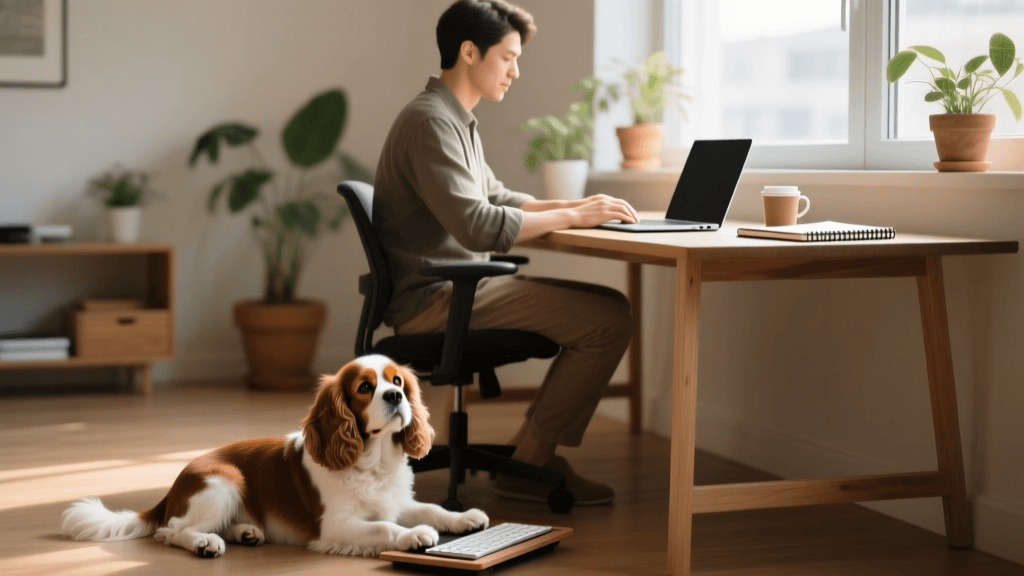
Unlike many toy breeds that were bred to be vocal alarm systems, the Cavalier was developed purely for companionship and lap-warming. Their psychological drive is centered around proximity to their human. However, what makes them superior to other companion breeds is their remarkable emotional stability and low neuroticism. A Cavalier is generally content just to be in the same room as you, requiring physical touch but not demanding active engagement. They are highly attuned to human emotions, offering silent, comforting support during high-stress workdays.
4. The Whippet: The Sensitive Observer
Similar to the Greyhound but in a more compact, apartment-friendly package, the Whippet is a sighthound that relies on visual stimuli rather than auditory. Because they are visually driven, they are less likely to bark at noises outside the window or in the hallway. Whippets are deeply bonded to their owners but possess a quiet dignity. They are highly sensitive to loud noises and chaotic environments, meaning they will naturally encourage you to maintain a calm, quiet home office atmosphere.
5. The Shih Tzu: The Low-Drive Lap Dog
Bred exclusively to sit in the laps of Chinese royalty, the Shih Tzu lacks the working, herding, or hunting drives that complicate many other breeds. Their psychological need is simply to be near their 'flock' (you) without the burden of a job to do. In 2026, modern veterinary guidelines heavily emphasize monitoring brachycephalic (flat-faced) breeds for respiratory health, but with proper climate control and short, low-intensity walks, their incredibly low exercise requirements and lack of territorial aggression make them seamless home office additions.
Breeds to Approach with Caution in a Home Office
Understanding breed instincts also means knowing which dogs are poorly suited for the WFH lifestyle. High-drive herding breeds, such as the Border Collie and Australian Shepherd, are psychologically wired to control movement and patrol their environment. In a home office, your fidgeting, pacing during phone calls, or even the movement of a robotic vacuum can trigger their herding instinct, leading to nipping, staring, and anxiety-inducing vocalization. Similarly, territorial guard breeds may view every delivery driver or neighbor passing the window as a threat, turning your workday into a series of barking interruptions.
2026 WFH Dog Behavior Comparison Chart
| Breed | Indoor Energy | Zoom-Call Vocalization | Independence Level | Best WFH Psychological Trait |
|---|---|---|---|---|
| Greyhound | Very Low | Rare | Moderate | Anaerobic recovery (deep sleep) |
| Basset Hound | Low | Low (occasional baying) | High | Energy conservation |
| Cavalier King Charles | Low to Moderate | Very Low | Low (Velcro) | Emotional mirroring and stability |
| Whippet | Low | Extremely Rare | Moderate | Visual (not auditory) reactivity |
| Shih Tzu | Very Low | Low | Low | Absence of working/prey drive |
Actionable Strategies for Managing WFH Dog Behavior
Even the most genetically predisposed WFH dog requires environmental management to thrive in a home office. Here are actionable, psychology-based strategies for 2026:
- Olfactory Enrichment over Physical Exercise: Before a long day of meetings, engage your dog's brain. Using a snuffle mat with 3-5 ounces of kibble forces them to use their olfactory cortex. According to the American Kennel Club's breed database, scent work is incredibly tiring for a dog's nervous system, promoting hours of calm resting behavior post-meal.
- Establish a 'Place' Command Boundary: Dogs thrive on spatial predictability. Set up a designated orthopedic mat at least 6 feet from your desk. Train a solid 'place' command so the dog understands that when you sit in your ergonomic chair, their job is to stay on their mat. This satisfies their need for a 'job' without interfering with your workflow.
- Hybrid Schedule Desensitization: To prevent the separation anxiety mentioned by the ASPCA, do not wait until your office mandates a return-to-work day to leave your dog alone. In 2026, utilize smart treat-tossing cameras to practice micro-absences. Leave for 30 minutes, toss a treat remotely, and return. This builds the psychological resilience needed for hybrid work schedules.
Conclusion
Choosing the right dog for a remote work lifestyle is about respecting canine psychology. By selecting breeds with low indoor arousal thresholds, adaptable independence, and quiet observational instincts, you create a harmonious environment where both you and your dog can thrive. Understanding your dog's ancestral drives is the ultimate key to a peaceful, productive home office in 2026 and beyond.
priya-sutaria
All our authors care for dogs every day — read more of their work on the authors page.