2 Hounds Freedom Harness Puppy Training Guide 2026
Discover how to stop puppy pulling in 2026 using the 2 Hounds Freedom No-Pull Harness. Includes sizing charts, fitting tips, and expert leash training steps.
The Challenge of Puppy Leash Pulling in 2026
Bringing a new puppy home is one of life’s greatest joys, but the honeymoon phase often hits a snag the moment you attach a leash. Between the ages of four and six months, puppies enter a critical developmental window characterized by intense environmental curiosity, teething discomfort, and adolescent boundary-testing. During this phase, leash pulling is not just a nuisance; it is a natural canine instinct to move toward stimuli. However, allowing a growing puppy to pull unchecked can lead to long-term behavioral issues and severe physical harm.
As we navigate dog ownership in 2026, modern veterinary behaviorists and certified professional dog trainers overwhelmingly recommend moving away from traditional aversive tools and standard neck collars. Instead, the focus has shifted entirely to biomechanically sound, force-free equipment. At the absolute top of the trainer-recommended list for growing, strong-willed puppies is the 2 Hounds Design Freedom No-Pull Harness. This comprehensive guide will break down exactly why this specific harness is the gold standard for puppy care, how to properly fit it to a rapidly growing canine body, and the step-by-step training protocol required to teach your puppy loose-leash walking.
Why Traditional Collars Fail Growing Puppies
Before diving into the solution, it is vital to understand why standard flat collars and slip leads are contraindicated for puppy leash training. A puppy’s trachea and cervical spine are still developing well into their first year. When a puppy pulls against a flat collar, the concentrated pressure is applied directly to the delicate structures of the neck.
According to veterinary experts, repeated pressure on the neck can lead to tracheal collapse, chronic coughing, and even restricted blood flow to the brain, which paradoxically increases a dog's arousal and reactivity levels. The American Kennel Club highlights that transitioning from a collar to a well-fitted harness is one of the most important steps an owner can take to protect their dog's physical health while training. You can read more about the biomechanical differences in the AKC’s guide on harnesses versus collars. By distributing force across the chest and shoulders, a proper harness eliminates the risk of tracheal damage while giving you superior leverage to guide your puppy’s movements.
Why the 2 Hounds Freedom Harness is the 2026 Gold Standard
The market is flooded with cheap, poorly constructed harnesses that cause chafing, allow escape, or fail to provide adequate steering control. The 2 Hounds Design Freedom No-Pull Harness stands out for several highly specific reasons that cater directly to the anatomy and psychology of a growing puppy:
- Swiss Velvet Lining: Puppy skin, particularly around the chest and behind the armpits, is exceptionally sensitive. The Freedom Harness features a luxurious Swiss velvet lining on the chest strap that prevents the chafing and hot spots commonly caused by nylon webbing.
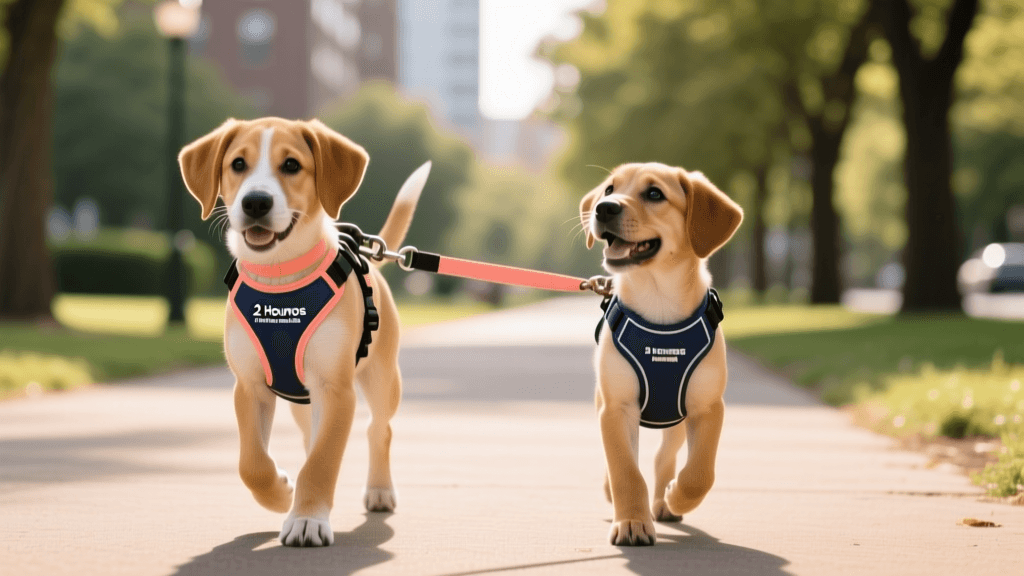
- Dual-Clip System: This harness features both a front chest ring and a back ring. The front ring is the secret weapon for leash training. When a puppy pulls, the front clip gently redirects their momentum back toward the owner, effectively turning the puppy around without causing pain.
- Four-Point Adjustment: Puppies grow in unpredictable spurts. A harness that only adjusts at the neck or chest will quickly become obsolete. The Freedom Harness offers four distinct adjustment points, allowing it to grow with your puppy and accommodate the broadening chest of adolescent breeds like Labrador Retrievers, Golden Retrievers, and German Shepherds.
- Structural Integrity: Unlike flimsy mesh harnesses that puppies can chew through or slip out of by backing up, the Freedom Harness utilizes a sturdy, reinforced nylon and stainless steel hardware construction that withstands the tantrums of a frustrated adolescent dog.
2026 Sizing Chart and Fitting Guide for Puppies
One of the most common mistakes new owners make is guessing their puppy's harness size based on weight alone. Weight is a secondary metric; chest girth is the primary measurement you must take. To measure your puppy, use a soft tailor’s tape measure and wrap it around the widest part of their ribcage, just behind the front legs.
Below is the 2026 sizing reference chart provided by the manufacturer to help you select the correct size for your growing puppy:
| Harness Size | Chest Girth (Inches) | Approximate Puppy Weight | Best For |
|---|---|---|---|
| Extra Small (XS) | 14" - 20" | 5 - 15 lbs | Small breeds (Chihuahuas, Toy Poodles), young medium breed pups |
| Small (S) | 18" - 26" | 15 - 30 lbs | Beagles, Corgis, adolescent small breeds |
| Medium (M) | 24" - 32" | 30 - 60 lbs | Border Collies, young Labs, Boxers |
| Large (L) | 28" - 38" | 60 - 90 lbs | Adolescent Golden Retrievers, German Shepherds, Rottweilers |
Pro-Tip for Growing Puppies: If your puppy's chest measurement falls exactly on the border between two sizes, always size up. The 2 Hounds Freedom Harness can be tightened significantly, but you cannot add fabric to a harness that is too small. A properly fitted harness should allow you to slide two fingers comfortably under any strap.
Step-by-Step Front-Clip Leash Training Protocol
Equipping your puppy with the right gear is only 20% of the battle; the remaining 80% is consistent, positive reinforcement training. The American Kennel Club emphasizes that consistency and rewarding the desired behavior are the cornerstones of stopping leash pulling. Here is the exact protocol to use with the front-clip of your Freedom Harness during your puppy's first year.
Step 1: The 'Be a Tree' Method
Attach your leash to the front chest ring of the harness. Begin walking in a low-distraction environment, such as your hallway or a quiet driveway. The absolute millisecond your puppy surges forward and the leash goes taut, stop walking immediately. Become a tree. Do not yank the leash; simply lock your arm to your body and stand still.
Step 2: The Redirection Effect
Because the leash is attached to the front of the chest, your puppy's forward momentum will naturally cause their body to swing back toward you. They will look back in confusion. The moment they turn their head toward you and the leash goes slack, mark the behavior with a verbal 'Yes!' or a clicker.
Step 3: Reward at the Seam
Deliver a high-value treat (like boiled chicken or freeze-dried liver) directly at the seam of your pant leg. This teaches the puppy that the 'reward zone' is right next to your leg, not five feet ahead at the end of a taut leash.
Step 4: The 180-Degree Turn
If your puppy is highly distracted and pulling toward a specific trigger (like a squirrel or another dog), the front clip allows you to execute a smooth 180-degree turn. Walk in the opposite direction without jerking the leash. The front clip will gently guide the puppy's shoulders to follow your new direction. Reward them heavily when they catch up to you.
Common 2026 Leash Training Mistakes to Avoid
"The fastest way to ruin a puppy's leash manners is to allow pulling on a retractable leash. Retractable leashes teach dogs that pulling is the mechanism that grants them more freedom." — Certified Professional Dog Trainers Association (CPDT-KA) Guidelines.
Even with the best no-pull harness, owners frequently sabotage their own progress by making a few critical errors:
- Using Retractable Leashes: Never pair a front-clip training harness with a retractable leash. The constant tension of a retractable leash reinforces pulling behavior and can damage the front ring of the harness over time. Use a standard 4-to-6-foot biothane or leather leash.
- Inconsistency Between Owners: If one parent uses the 'Be a Tree' method and the other allows the puppy to pull toward the fire hydrant, the puppy will learn that pulling works 50% of the time. Variable reinforcement makes a behavior much harder to extinguish.
- Rushing the Distraction Ladder: Do not start training in a busy park. Puppies lack the neurological maturity to process high-level distractions. Start in your living room, move to the backyard, then the front yard, and only then to the neighborhood sidewalk.
Transitioning to the Back-Clip: The Ultimate Goal
The front-clip is a training tool, not necessarily a lifelong necessity for every dog. As your puppy matures past the one-year mark and their loose-leash walking becomes a reliable habit, you can begin transitioning to the back-clip ring located between the shoulder blades.
The back-clip is ideal for recreational sniffaris, hiking, and running, as it allows the dog a full, unrestricted range of motion without the leash tangling between their front legs. To transition safely, use a dual-clip leash (a leash that attaches to both the front and back rings simultaneously). This allows you to apply gentle front-clip steering if the puppy regresses into pulling, while giving them the freedom of the back-clip when they are walking politely.
Conclusion: Investing in Your Puppy's Future
The first year of a puppy's life is a fleeting, formative period. The habits you establish now will dictate your dog's walking etiquette for the next decade. By investing in a biomechanically superior tool like the 2 Hounds Design Freedom No-Pull Harness and pairing it with patient, positive reinforcement training, you are protecting your puppy's physical development and building a bond based on trust rather than force. Remember that adolescent regression is normal; stay consistent, keep your treats handy, and enjoy the journey of raising a well-mannered canine companion in 2026 and beyond.
robin-maitland
All our authors care for dogs every day — read more of their work on the authors page.